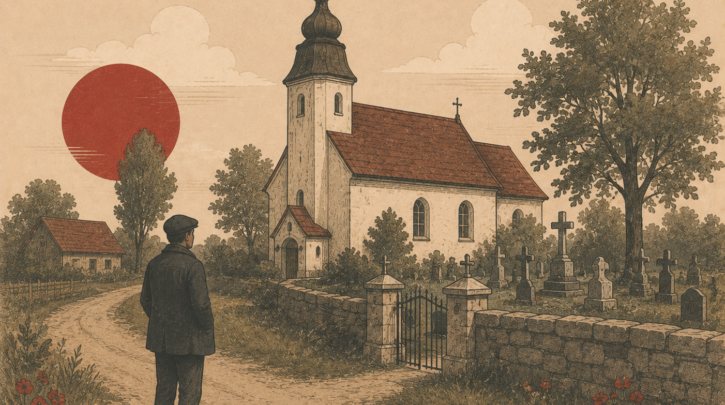

The village is usually smaller than you imagined. And quieter. And more ordinary — a church, a handful of streets, a few dozen houses. But standing there, knowing your great-great-grandmother was baptised in that church and walked that lane to market, the ordinary becomes something else entirely.
Visiting an ancestral village in Poland is one of the most emotionally complex experiences in heritage travel — combining the satisfaction of research completed, the strangeness of encountering a place you’ve never been but somehow feel connected to, and occasionally the grief of finding only foundations where a house once stood. This guide prepares you for the reality of that visit: what you’ll find, what you might not find, how to navigate the experience, and how to make it as meaningful and productive as possible.
Table of Contents
- Before You Arrive: Setting Realistic Expectations
- First Impressions: What Polish Villages Actually Look Like
- The Church: Your First Stop
- The Cemetery: Where the Past Is Most Present
- Talking to Local Residents
- What Survives and What Doesn’t
- Visiting Former Jewish Communities
- Documenting Your Visit
- The Emotional Dimension
- After the Visit: Continuing the Research
- Final Thoughts
Before You Arrive: Setting Realistic Expectations
The ancestral village of your imagination — shaped by family stories, sepia photographs, and emotional longing — is rarely the village you’ll find. That gap between expectation and reality isn’t a failure; it’s simply what happens when 100 years of history have passed over a place. Preparing for that gap means the reality can be received for what it is rather than mourned for what it isn’t.
What most heritage travellers find: a living community whose connection to your family’s history is real but mostly invisible on the surface. The houses your ancestors lived in are almost certainly gone, replaced or rebuilt multiple times since emigration. The surnames in the cemetery may or may not match your family’s. The people who live there now may know nothing about families who left 100 years ago. And the landscape — the fields, the river, the curve of the road — may be the most tangible connection to what your ancestors actually experienced.
First Impressions: What Polish Villages Actually Look Like
Polish villages vary enormously by region. A village in the Tatra mountain foothills looks nothing like one on the flat plains of Mazovia; a Galician village has a different character from one in the former Prussian partition. But certain features are common: a Catholic church (almost always the oldest and most prominent building), a cemetery adjacent to or near the church, a central road or square, and houses arranged along that road — often with gardens extending behind them.
Many Polish villages are still actively farmed. Others are primarily residential communities for people who commute to nearby towns. A few have become depopulated and feel emptier than expected. All of them are real places where real people live now — approaching the visit with that awareness shapes the experience positively.
The Church: Your First Stop
The parish church is almost always the right place to start a village visit. In Catholic Poland, the church was the centre of community life for centuries — your ancestors were baptised there, married there, and had their deaths recorded there. The building itself may date to the 18th or 19th century, sometimes earlier.
If the church is open, go inside. Look for memorial plaques, family coats of arms, and any historical inscriptions that might reference your family name. Find the parish office and introduce yourself. Parish priests and office administrators range from warmly welcoming to efficiently businesslike — either way, they can often confirm whether the family name appears in surviving parish records.
The Cemetery: Where the Past Is Most Present
The parish cemetery is typically adjacent to the church or a short distance away. Polish Catholic cemeteries are maintained with striking care — graves are decorated with candles and flowers, and the cemetery is treated as an active community space rather than a forgotten place.
Walk the cemetery systematically. Look for your family surname on gravestones — even if the individuals aren’t direct ancestors, they may be cousins or family members who remained in the village. Note the date ranges on family plots. Photograph everything — the full stone, the inscription in close-up, and the surrounding context.
Tip: Bring rubbing materials (paper and soft crayon) for worn inscriptions. Grave rubbing can reveal text that’s invisible in photographs taken in flat light.
Talking to Local Residents
The most unexpected and often most valuable part of a village visit is a conversation with a long-time resident. Older villagers often have remarkable memories of community history — they remember family names from decades ago, recall stories about families who emigrated, and sometimes know exactly which house a particular family lived in.
Approach these conversations with patience, a translator if possible, and photographs. Showing an old photograph of the family you’re looking for — particularly one that might have been taken in the village before emigration — can produce extraordinary responses. The local shop, the post office, and the church are the best places to find people willing to talk.
What Survives and What Doesn’t
Polish villages were devastated during both World Wars — particularly those in eastern Poland that experienced repeated military occupation. Many villages were partially or completely destroyed; what exists today was often rebuilt after 1945. The farmhouse your ancestors lived in almost certainly no longer stands in its original form.
What typically does survive: the church (often rebuilt or restored if damaged), the cemetery layout, the general geography — the road, the river, the surrounding fields — and sometimes the village name itself on older structures or in local memory. Monuments and memorial plaques sometimes reference specific historical events or community members, occasionally including emigrant families.
Visiting Former Jewish Communities
For researchers with Polish-Jewish ancestry, the ancestral village visit carries additional layers of history and loss. Most Polish towns and villages with significant pre-war Jewish populations contain almost no visible trace of that community today — the synagogue was destroyed, the Jewish quarter was demolished, and the Jewish cemetery was either destroyed or is overgrown and forgotten.
Before visiting a former Jewish community, research what’s known about what survives. The Virtual Shtetl project (sztetl.org.pl) documents surviving Jewish heritage sites in Poland. Many heritage travellers find these visits among the most powerful of their lives precisely because of the weight of what is absent.
Documenting Your Visit
Document everything, systematically. Photograph the church exterior and interior, every gravestone in the family plot and its neighbours, the village sign, the landscape and streetscape, and any documents or photographs you’re shown by locals or parish staff.
Keep a written log of conversations — note who you spoke to, what they told you, and any leads they provided. Take GPS coordinates of significant locations so you can locate them precisely for future reference or share them with other family members.
The Emotional Dimension
Heritage travel to an ancestral village is not a neutral research exercise. Most people who make these trips report emotions they didn’t fully anticipate — a sense of recognition in a place they’ve never been, grief for what was lost, gratitude for what survives, and something harder to name: a feeling of completing a circuit that has been open for generations.
Allow yourself time to simply be in the place without an agenda. Sit in the church. Walk the cemetery slowly. Stand at the edge of the fields your ancestors farmed. The research has been done; the documents have been found. This is the moment to receive what the place itself has to offer.
After the Visit: Continuing the Research
A village visit almost always generates new research leads — names on gravestones to check in vital records, a resident’s mention of a family who might be related, a parish register reference that warrants a follow-up archive request. Organise these leads while they’re fresh and follow them up when you return home.
If you’re pursuing Polish citizenship by descent, records obtained during your trip — certified copies from archives and photographs of vital record pages — form part of your documentary evidence. Our guide to Polish citizenship documents covers what format is required for official use.
Final Thoughts
An ancestral village visit is, in the end, a pilgrimage — not in any religious sense necessarily, but in the sense of a journey to a place that holds meaning beyond its physical reality. The village is ordinary; what you bring to it makes it extraordinary. Bring preparation, bring patience, bring openness to what you’ll find rather than rigidity about what you expected.
For the full heritage trip planning guide — including how to contact archives in advance, arrange translations, and make the most of every day in Poland — see our guide to how to plan a heritage trip to Poland. Subscribe to our newsletter for weekly Polish heritage guides.