
Of all the breakthroughs in Polish genealogy research, finding the village is the one that changes everything. Before you know it, you’re searching a country. After you know it, you’re searching one community — one parish, one set of records, one place on the map where your family’s story begins.
For most people researching Polish ancestry, the village name is the missing piece that unlocks everything else. This guide covers every method available for finding your ancestor’s village in Poland — from the family documents you might already have, through the immigration records that often hide the answer in plain sight, to the genealogical tools and strategies that work even when the obvious sources come up empty.
Table of Contents
- Why the Village Name Matters So Much
- Start With Family Sources
- Immigration Records: Your Best Friend
- Death Certificates and Obituaries
- Naturalisation Records
- US Census Records
- Immigrant Parish Records
- Gazetteers and Historical Place-Name Tools
- DNA Matching as a Village-Finding Tool
- Once You Have the Village: What Next?
- Final Thoughts
Why the Village Name Matters So Much
Poland has tens of thousands of villages and hundreds of towns, each with its own parish and civil registration district. Without knowing which community your ancestor came from, a surname search is like searching a phone book without a city — you might find the name, but you can’t confirm which entry is yours. With the village, you know exactly which parish register to search, which archive holds it, and which community to focus your research on.
The village name also unlocks lateral research — finding siblings, cousins, and neighbours who share the same community, which in turn often leads to record sets that help break through brick walls in your direct line.
Not sure where to start with your Polish ancestry?
Get the Polish Genealogy Quick-Start Checklist — a 6-step path to your first real ancestor record, plus the 5 terms you’ll see everywhere and direct links to the free archives you need. No subscription required.
Start With Family Sources
Before going to any database or archive, exhaust your family’s own knowledge and documents. The village name is often hiding in plain sight.
Talk to Older Relatives
Ask directly: where in Poland did our family come from? Even imprecise answers — “somewhere near Kraków,” “a village in the mountains,” “the Russian part” — are useful starting points. Some relatives know the village name perfectly well but have never been asked. Others carry the name in their memory but don’t realise it’s significant. Prompt with specifics: do you remember the name of a town or village? Was there a local church name? Did anyone ever mention a region?
Search Family Documents
Old family papers often contain the village name without anyone realising it. Check: passports (the birthplace field), old letters (return addresses from Poland), religious certificates from Polish parishes (sometimes list the village of origin), and family bibles or photograph inscriptions. Even a handwritten label on the back of a photograph — “Babcia w Rzeszowie, 1912” — can be a major clue.
Immigration Records: Your Best Friend
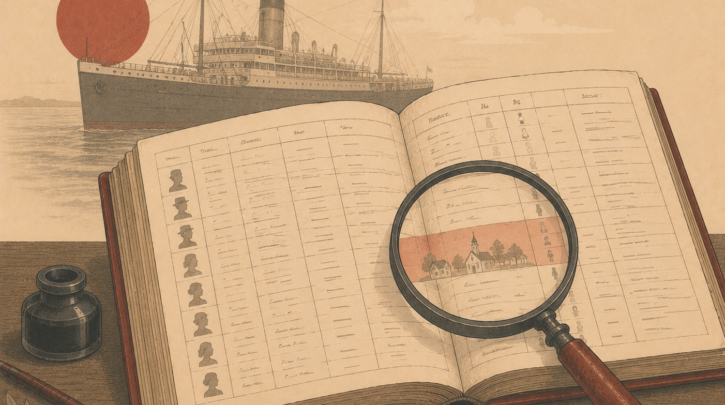
For the vast majority of descendants of Polish emigrants who arrived in North America between 1880 and 1924, ship passenger manifests are the single most reliable source of village-level origin information. The level of detail in these manifests increased dramatically after 1906, when US immigration law required new and more comprehensive data collection.
Post-1906 Ship Manifests
From 1906, US ship manifests required the passenger to list their last permanent residence (column 8 — often a specific village), the name and address of their nearest relative in their country of origin (column 11 — frequently a sibling, parent, or spouse with a village address), and the name and address of their contact in the US. The “nearest relative in home country” column is particularly valuable: it often gives a specific village name, a street, and the name of a relative who may appear in Polish records.
Manifests from the major immigration years are searchable through the Ellis Island Foundation database (for New York arrivals), Ancestry, FamilySearch, and Fold3. Search by your ancestor’s name, filtering by approximate arrival year. When you find a plausible match, examine the full manifest page rather than just the indexed data — nearby entries are often relatives or neighbours from the same village travelling together.
Pre-1906 Manifests
Older manifests collected less detail — typically just name, age, marital status, occupation, and destination. They may list country of origin (Russia, Austria, Germany — the imperial designation rather than Poland) but rarely list a specific village. They’re still worth checking for name spelling and approximate time of arrival, which helps narrow down other searches.
Canadian and Australian Immigration Records
Canadian passenger lists (searchable through Library and Archives Canada and Ancestry) also record last place of residence and can contain village-level information. Australian immigration records vary by state but are increasingly digitised; the National Archives of Australia’s RecordSearch is the primary portal.
Death Certificates and Obituaries
Death certificates often contain the decedent’s place of birth — and for immigrants who registered their Polish birthplace rather than their immigration country, this can be remarkably specific. Not all states or countries required birthplace on death certificates, and not all informants (usually a family member) knew the specific village. But when they do, it’s invaluable.
Polish-language newspapers published in diaspora communities — the Polish Daily News (Dziennik Polski), the Polish-language press in Chicago, the Polish press in western Canada — often published detailed obituaries for community members that named the village of origin. Ethnic newspapers are increasingly digitised through the Chronicling America project (US), and some Polish-language papers have their own archives.
Naturalisation Records
Post-1906 US naturalisation petitions required the applicant to list their town or city of birth. The quality of this information varies — some petitioners listed their village precisely; others listed the nearest large town. Either way, it narrows the geographic target significantly.
US naturalisation records are searchable through Ancestry’s naturalisation index, FamilySearch, and the USCIS Genealogy Program for more recent records. For older records (pre-1906), you’ll need to identify which court handled the naturalisation and contact that court or the relevant state archive directly.
US Census Records
The US federal census from 1900 onward asked for country of birth (and parents’ countries of birth), year of immigration, and mother tongue. While it rarely specifies a village, it can narrow the partition zone — a person listed as born in “Russia” with mother tongue “Polish” was from the Russian partition; one listed as born in “Austria” with mother tongue “Polish” or “Ruthenian” was likely from Galicia.
Census records are most useful in conjunction with other sources. A naturalization record that gives a town name, combined with a census record giving an approximate immigration year, combined with a ship manifest from that year, often triangulates to a specific village.
Immigrant Parish Records
Polish immigrants typically joined Polish Catholic parishes in their new communities, and those parishes kept records of their own. Baptism records from a Polish immigrant parish in Chicago or Pittsburgh sometimes list the parents’ birthplace in Poland — including the specific village. Marriage records may list the village of origin for both parties. Some immigrant parishes also kept membership registers that recorded where each family came from.
Polish immigrant parish records in the US are not systematically digitised, but many dioceses maintain archives and respond to genealogical inquiries. Contact the diocese or the specific parish directly and ask about their historical records.
Gazetteers and Historical Place-Name Tools
Once you have a village name — or a partial name, or a phonetically mangled version from an immigration record — you need to identify exactly where it is and what it’s called today. Village names in Poland changed repeatedly under different administrations, and some villages were renamed, merged, or simply ceased to exist.
- Kartenmeister — a gazetteer of former German Eastern territories, useful for the Prussian partition and Silesia
- Słownik Geograficzny Królestwa Polskiego — the definitive 19th-century geographic dictionary of Polish lands, partially available online and invaluable for Russian and Austrian partition place-name research
- Shtetl Seeker (jewishgen.org) — specifically useful for identifying Jewish community locations, many of which overlap with Polish village research
- Google Maps with historical layer tools — for confirming modern locations of historically-named places
- Herder Institut Kartenportal — high-resolution historical maps of Central and Eastern Europe, useful for locating places on historical maps
DNA Matching as a Village-Finding Tool
DNA matching — comparing your results with other tested individuals who share significant segments of DNA — can help identify geographic origins even when documentary sources are silent. If several of your strong DNA matches have researched their ancestry to the same region or village cluster of Poland, that’s a meaningful geographic signal.
This approach works best when you have matches who have done thorough genealogical research and know their own Polish origins. Tools like the Shared cM Project, DNA Painter, and GEDmatch’s geographic analysis features can all help interpret what your matches tell you about geographic origin. It’s a supplement to documentary research, not a replacement — but for families with genuinely lost records, it can be the decisive clue.
Once You Have the Village: What Next?
With a village name confirmed, the research pathway becomes clear. Identify the historical parish that served the village using Geneteka’s parish list or the Słownik Geograficzny. Search Geneteka for surname entries in that parish. Browse the parish records on Metryki or Szukaj w Archiwach. Contact the relevant state archive for records not yet digitised.
If citizenship is part of your goal, the village identification is also the key to locating your ancestor’s birth record in Polish archives — a document that’s often the linchpin of a citizenship application. Our guide to Polish citizenship documents covers exactly how to request certified copies from Polish archives.
Not sure where to start with your Polish ancestry?
Get the Polish Genealogy Quick-Start Checklist — a 6-step path to your first real ancestor record, plus the 5 terms you’ll see everywhere and direct links to the free archives you need. No subscription required.
Final Thoughts
Finding your ancestor’s village is a research challenge, but it’s also one of the most solvable ones in Polish genealogy — because the answer is almost always hiding somewhere in the records that already exist. Ship manifests, naturalisation petitions, death certificates, and immigrant parish records collectively contain village-level information for a significant majority of Polish emigrants who arrived in the late 19th and early 20th centuries.
Be systematic, be thorough, and use multiple source types to triangulate. When you find it, write it down with the source — future you (and any citizenship application) will thank you. Continue your research with our guide to using Geneteka to search within your ancestor’s parish, or return to the Complete Beginner’s Guide for the full research roadmap. Subscribe to our newsletter for weekly Polish heritage guides.