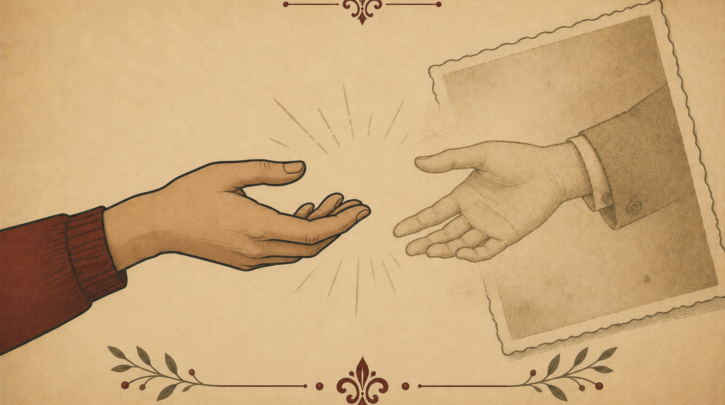

Something shifts when you find the record. It might be a baptism entry in a priest’s handwriting, or a ship manifest with your great-grandmother’s name in a column headed “last place of residence,” or a photograph in a yizkor book of a street that no longer exists. Whatever it is, it makes the abstract concrete — the family story becomes a documented life, the homeland becomes a specific village on a specific map, and the identity you’d held loosely becomes something you can hold with both hands.
Reclaiming Polish heritage is a phrase that means different things to different people. For some it’s genealogical research — the systematic recovery of names, dates, and places. For others it’s the pursuit of citizenship — a legal claim to a national identity their ancestors held. For others still it’s something more personal and less definable: a need to understand where their family came from, to feel the weight of that history, and to carry it forward consciously rather than let it dissipate into generic “European” ancestry. This guide explores what reclaiming Polish heritage actually involves — practically, emotionally, and culturally — and offers a framework for the journey, wherever you are in it.
Table of Contents
- Why Now? The Polish Heritage Revival
- What Reclaiming Heritage Actually Means
- Starting With Genealogy: The Foundation
- The Language Question
- Engaging With Polish Culture
- Finding Your Community
- Citizenship as an Act of Reclamation
- The Power of Going There
- Passing It On: Heritage for the Next Generation
- The Complexity of Reclaimed Identity
- Final Thoughts
Why Now? The Polish Heritage Revival
Interest in Polish heritage has accelerated dramatically over the past two decades, driven by several converging forces. DNA testing made it possible for millions of people to confirm ancestry they’d only heard about in family stories. The digitisation of genealogical records made the research genuinely accessible to non-specialists for the first time. Poland’s EU membership created practical reasons to pursue Polish citizenship — an EU passport is a tangible benefit, not just a symbolic one. And something cultural has shifted too: a generation raised in an era of identity consciousness has rediscovered an interest in ethnic and national heritage that their parents’ generation often consciously abandoned in the name of assimilation.
The result is a heritage revival of remarkable scale. Genealogy databases are flooded with Polish searches. Polish consulates have multi-year backlogs for citizenship applications. Heritage tourism to Poland has grown consistently. Something significant is happening — a reclamation of identity that was put down, generation by generation, in the long process of becoming American or British or Australian.
What Reclaiming Heritage Actually Means
Reclaiming heritage isn’t about pretending continuity that doesn’t exist. You’re not Polish in the way your great-grandmother was Polish — you don’t speak the language as a mother tongue, you didn’t grow up in the community she grew up in, you don’t carry the same cultural assumptions or the same historical memory. Pretending otherwise would be a kind of performance rather than a genuine engagement.
What reclaiming heritage does mean is choosing to acknowledge, understand, and engage with a significant strand of your family’s identity rather than letting it remain a vague background fact. It means knowing the names of the ancestors who made the journey that ultimately produced you. It means understanding the historical context of their lives — the poverty or violence or ambition that drove emigration, the specific places they came from, the community they were part of before they left. And it means deciding, in the present, what relationship you want to have with all of that.
Starting With Genealogy: The Foundation
For most people, the reclamation journey begins with genealogy — the systematic research that recovers names, dates, and places. This is where the abstract becomes concrete: the great-grandmother who was “from Poland somewhere” becomes Maria Wiśniewska, born 1882 in the village of Niwiska in Galicia, daughter of Józef and Katarzyna née Kowalczyk, who emigrated to Pennsylvania in 1903 at the age of 21.
That specificity is what makes everything else possible. Without it, heritage engagement is generic. With it, you have a story — a real place on a real map, a family that can be researched further, visited, and in some cases connected with living descendants who never left. Our Complete Beginner’s Guide to Polish ancestry research walks through the entire research process. If you haven’t started the genealogy yet, that’s where to begin.
The Language Question
Polish is a notoriously challenging language for English speakers — complex grammatical gender, seven cases, and a sound system that includes consonant clusters most English speakers have never had to produce. It’s also a beautiful language, deeply expressive, with a literary tradition that includes some of the finest poetry in European history.
Learning Polish as a heritage speaker is one of the most meaningful ways to engage with Polish identity. It opens records, enables conversations in Poland, and creates a direct relationship with the cultural inheritance that language carries. The question isn’t whether to learn Polish but what level of fluency serves your goals. Genealogy-functional Polish is achievable in months. Conversational Polish takes years. Start where you are and build toward what matters most to you.
Engaging With Polish Culture
Polish cultural heritage is extraordinarily rich — in literature, music, art, philosophy, film, and cuisine. Chopin’s nocturnes carry something of Poland in them — the melancholy and the lyricism of a nation that spent 123 years without a state and whose artists kept its spirit alive in exile. Wisława Szymborska’s poetry (available in excellent English translations) is among the finest of the 20th century. Andrzej Wajda’s films illuminate Polish history in ways that no history book quite achieves. Polish cuisine — pierogi, bigos, żurek, barszcz — is a living tradition that connects food to season, region, and family memory.
Engaging with Polish culture doesn’t require performing ethnicity. It means genuinely encountering works, ideas, and traditions that are part of the cultural inheritance your family once participated in — and deciding which elements feel alive and meaningful to you.
Finding Your Community
One of the most underappreciated aspects of heritage reclamation is finding other people on the same journey. The Polish genealogy community is large, generous, and genuinely international — researchers in Australia and Canada and Argentina all connected by the common project of recovering Polish family history.
Online communities — Facebook groups like Polish Genealogy, Polish Heritage USA, and Polska Genealogia; the Polish Genealogical Society of America; JewishGen’s Poland Special Interest Group — provide forums for questions, shared research, and the particular pleasure of talking to people who understand exactly why you spent three hours deciphering a 19th-century Cyrillic record. Community is not just emotionally valuable — it’s practically useful. Other researchers have often already found the records you’re looking for.
Citizenship as an Act of Reclamation
For many people, the most concrete and consequential act of heritage reclamation is pursuing Polish citizenship by descent. This is a legal process — documented in our Complete 2026 Guide to Polish Citizenship by Descent — but it carries a significance beyond the practical. To hold a Polish passport is to have a national identity formally recognised by the Polish state: you are not merely a descendant of Poles, you are yourself Polish, in the eyes of the country your ancestors came from.
The process is demanding — it requires documented ancestry, certified vital records, sworn translations, and patience across a timeline measured in years. But the people who complete it consistently describe it as one of the most meaningful things they’ve done — a formal acknowledgment of connection that genealogical research alone doesn’t quite provide. Polish citizenship also has practical dimensions: EU freedom of movement, the right to live and work across 27 EU member states, and the ability to pass the citizenship to your children.
The Power of Going There
Nothing in heritage reclamation substitutes for going to Poland. Seeing the church where your ancestors were baptised, walking the village streets they walked, standing at the graves of people who share your surname — these experiences operate at a register that genealogy research and cultural engagement can approach but not reach.
Poland itself is also a country worth knowing independently of the heritage motivation: a vibrant democracy with a remarkable history, extraordinary architecture, world-class museums, and a contemporary culture that is confidently itself. Our guide to planning a heritage trip to Poland covers the practical preparation in full detail.
Passing It On: Heritage for the Next Generation
Heritage reclamation that stops with you is heritage half-recovered. The most durable legacy of this work is what passes to the next generation — not as an obligation or an identity they must perform, but as a story they know, a connection they can choose to explore if they wish, and a documented family history that exists because someone in their family cared enough to recover it.
Polish citizenship, once confirmed, passes to your children. The genealogical research you do becomes a resource for your descendants. The relationships with Polish relatives, if you find them, create ties that outlast any individual. And the habit of curiosity about where the family came from — that’s perhaps the most valuable inheritance of all.
The Complexity of Reclaimed Identity
Reclaimed heritage is never simple. Your Polishness — if you claim it — coexists with your American-ness, your British-ness, your Australian-ness. It may coexist with other heritage strands: Irish, German, Italian, Jewish. The claim is real but it’s also partial, and honest engagement with heritage means holding that complexity rather than resolving it into a tidy identity narrative.
For descendants of Polish Jews, the complexity is particularly layered: Polish and Jewish identities have a relationship that is both deeply intertwined and historically painful, and claiming one doesn’t erase or diminish the other. These complexities don’t undermine the reclamation project; they enrich it.
Final Thoughts
Every person who traces their Polish ancestry, visits an ancestral village, claims citizenship, or simply learns the names of the great-grandparents who made a journey that eventually produced them — every one of these people is participating in something larger than individual family research. They’re participating in the ongoing conversation between Poland and its diaspora: a conversation about identity, memory, loss, and belonging that has been happening for two centuries and shows no sign of ending.
You don’t have to be fluent in Polish, or hold a Polish passport, or have visited Warsaw to have a genuine relationship with Polish heritage. You need only be curious, honest, and willing to do the work of finding out. The records are increasingly accessible. The community is welcoming. And the story, when you start to find it, is almost always richer and more interesting than you expected.
Start where you are. Polish Roots Project exists to support every stage of this journey — from your first surname search through your citizenship confirmation and beyond. Explore our Genealogy Research guides, our Citizenship by Descent hub, and our Heritage Travel guides for the resources you need at every step. And subscribe to our newsletter — because this is a journey best travelled with company.