
At some point in every Polish genealogy researcher’s journey, they encounter a word they don’t recognise in a record they desperately need to read. This glossary exists for exactly that moment.
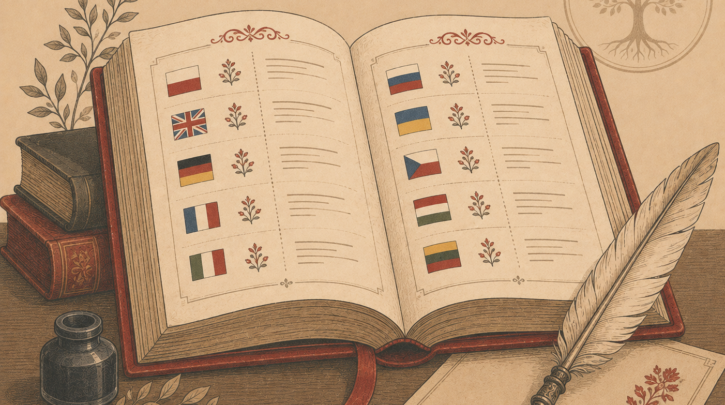
Polish genealogical records span four languages — Polish, Latin, Russian, and German — and several centuries of evolving terminology. This reference covers the most common and most important terms you’ll encounter across all four systems: record-type vocabulary, relationship terms, occupational designations, status indicators, and the administrative and geographic terms that appear throughout parish registers and civil registration documents. Bookmark it and return to it whenever a word stops you.
Table of Contents
- Vital Event Terms (Birth, Marriage, Death)
- Relationship and Family Terms
- Status and Legitimacy Terms
- Occupational Terms
- Geographic and Administrative Terms
- Common Given Name Equivalents
- Month Names Across All Four Languages
- Record and Document Type Terms
- Archive and Research Terms
Vital Event Terms (Birth, Marriage, Death)
Birth and Baptism
- urodzony/urodzona (Polish) — born (m/f); also urodzenie — birth
- ochrzczony/ochrzczona (Polish) — baptised (m/f)
- chrzciny (Polish) — baptism ceremony
- natus/nata (Latin) — born (m/f)
- baptizatus/baptizata (Latin) — baptised (m/f)
- родился/родилась rodilsya/rodilas’ (Russian) — was born (m/f)
- geboren (German) — born; getauft — baptised
Marriage
- ślub (Polish) — wedding/marriage; małżeństwo — marriage (the institution)
- zaślubiony/zaślubiona (Polish) — married (m/f)
- pan młody (Polish) — groom; panna młoda — bride
- copulati/copulavit (Latin) — married/joined in marriage
- sponsus (Latin) — groom; sponsa — bride
- браком сочетались brakom sochetalis’ (Russian) — were married
- жених zhenikh (Russian) — groom; невеста nevesta — bride
- getraut/geheiratet (German) — married; Bräutigam — groom; Braut — bride
Death and Burial
- zgon (Polish) — death; śmierć — death; zmarł/zmarła — died (m/f)
- pochowany/pochowana (Polish) — buried (m/f)
- obiit (Latin) — died; sepultus/sepulta — buried (m/f)
- defunctus/defuncta (Latin) — deceased (m/f)
- умер/умерла umer/umerla (Russian) — died (m/f)
- gestorben (German) — died; begraben — buried
Relationship and Family Terms
- ojciec (Polish) / pater (Latin) / отец otets (Russian) / Vater (German) — father
- matka (Polish) / mater (Latin) / мать mat’ (Russian) / Mutter (German) — mother
- syn (Polish) / filius (Latin) — son; córka (Polish) / filia (Latin) — daughter
- dziadek (Polish) — grandfather; babcia/babka — grandmother
- brat (Polish) — brother; siostra — sister
- wuj/stryj (Polish) — uncle (maternal/paternal); ciotka — aunt
- kuzyn/kuzynka (Polish) — cousin (m/f)
- małżonek/małżonka (Polish) — husband/wife; mąż — husband; żona — wife
- wdowiec (Polish) — widower; wdowa — widow; viduus/vidua (Latin) — same
- z domu (Polish) / geborene (German) / урождённая urozhdyonnaya (Russian) — née (maiden name indicator)
- chrzciny kumowie / rodzice chrzestni (Polish) — godparents; patrini (Latin) — godparents
- świadkowie (Polish) / testes (Latin) / свидетели svideteli (Russian) / Zeugen (German) — witnesses
Status and Legitimacy Terms
- ślubny/ślubna (Polish) / legitimus/legitima (Latin) / законный/законная zakonny/zakonnaya (Russian) / ehelich (German) — legitimate (m/f)
- nieślubny/nieślubna (Polish) / illegitimus/illegitima (Latin) / незаконный/незаконная nezakonny (Russian) / unehelich (German) — illegitimate (m/f)
- pan (Polish) — Mr./Sir (also indicates married man); panna — Miss (unmarried woman)
- szlachcic (Polish) / nobilis (Latin) — nobleman; szlachcianka — noblewoman
- chłop (Polish) / agricola (Latin) — peasant farmer
Occupational Terms
- rolnik/gospodarz (Polish) / agricola/colonus (Latin) — farmer
- kowal (Polish) / faber ferrarius (Latin) — blacksmith
- karczmarz (Polish) — innkeeper/tavern keeper
- krawiec (Polish) / sartor (Latin) — tailor
- szewc (Polish) / sutor (Latin) — shoemaker
- cieśla (Polish) / faber lignarius (Latin) — carpenter
- ksiądz (Polish) / sacerdos/presbyter (Latin) — priest
- nauczyciel (Polish) — teacher; organista — church organist
- sołtys (Polish) / scultetus (Latin) — village headman
- żołnierz (Polish) / miles (Latin) — soldier
Geographic and Administrative Terms
- wieś/wioska (Polish) — village; miasto — town; miasteczko — small town
- gmina (Polish) — administrative commune; powiat — county/district
- gubernia (Russian partition) — province (largest administrative unit); Gouvernement (German equivalent)
- parafia (Polish) / parochia (Latin) — parish
- dekanat (Polish) — deanery (group of parishes)
- diecezja (Polish) / dioecesis (Latin) — diocese
- Kreis (German, Prussian partition) — administrative district; Bezirk — district
- województwo (Polish, modern) — voivodeship (modern province)
Common Given Name Equivalents
The same person’s given name often appears in different forms across records in different languages and eras:
- Jan (Polish) / Joannes/Johannes (Latin) / Иван Ivan (Russian) / Johann/Hans (German) / John (English)
- Józef (Polish) / Josephus (Latin) / Иосиф Iosif (Russian) / Joseph (German/English)
- Stanisław (Polish) / Stanislaus (Latin) / Станислав Stanislav (Russian) / Stanley (English)
- Wojciech (Polish) / Adalbertus (Latin) / Войцех Voitseкh (Russian) / Albert/Victor (English)
- Maria/Maryja (Polish) / Maria (Latin) / Мария Mariya (Russian) / Mary (English)
- Katarzyna (Polish) / Catharina (Latin) / Катерина Katerina (Russian) / Catherine/Kate (English)
- Anna (Polish/Latin/Russian/German) / Anne/Hannah (English)
- Franciszek (Polish) / Franciscus (Latin) / Франциск Frantsisk (Russian) / Frank/Francis (English)
Month Names Across All Four Languages
Month names are among the most commonly needed translations in record reading:
- January: styczeń (Polish) / Januarius (Latin) / январь yanvar’ (Russian) / Januar (German)
- February: luty / Februarius / февраль fevral’ / Februar
- March: marzec / Martius / март mart / März
- April: kwiecień / Aprilis / апрель aprel’ / April
- May: maj / Maius / май may / Mai
- June: czerwiec / Junius / июнь iyun’ / Juni
- July: lipiec / Julius / июль iyul’ / Juli
- August: sierpień / Augustus / август avgust / August
- September: wrzesień / September / сентябрь sentyabr’ / September
- October: październik / October / октябрь oktyabr’ / Oktober
- November: listopad / November / ноябрь noyabr’ / November
- December: grudzień / December / декабрь dekabr’ / Dezember
Record and Document Type Terms
- metryka (Polish) — vital record/certificate; metryki — vital records (pl.)
- akt urodzenia — birth record; akt małżeństwa — marriage record; akt zgonu — death record
- odpis skrócony — short (abbreviated) extract; odpis zupełny — full (complete) extract
- księga metrykalna — metrical book (parish register)
- księga ludności — population register/household book
- spis ludności — census/population list
Archive and Research Terms
- archiwum (Polish) — archive; archiwum państwowe — state archive
- fond — archival collection/fonds
- sygnatura — archival reference number
- USC — Urząd Stanu Cywilnego (Civil Registry Office)
- kwerenda — archive research request
- uwierzytelnienie — certification/authentication
- apostille — international certification under the Hague Convention
- tłumacz przysięgły — sworn/certified translator
Return to this glossary whenever you encounter an unfamiliar term in a record. For more context on reading the records themselves, see our full guide on how to read old Polish records. And to start applying your vocabulary to real record searches, our guide on using Geneteka shows you exactly what you’ll find in the index. Subscribe to our newsletter for weekly Polish heritage guides.