 Written by: Polish Roots Project (Editorial Team)
Posted on: May 8, 2026
Written by: Polish Roots Project (Editorial Team)
Posted on: May 8, 2026How to Research Polish Ancestors from the Kresy (Eastern Borderlands)
The Kresy — Poland’s eastern borderlands — were once home to millions of Poles, Ukrainians, Belarusians, Lithuanians, and Jews living alongside each other in a landscape that changed political ownership multiple times within living memory. Today, the Kresy lie in Lithuania, Belarus, and Ukraine. The…
Written by: Polish Roots Project (Editorial Team)
Posted on: May 8, 2026Polish Nobility Research: A Guide for Szlachta Descendants
Polish nobility — the szlachta — was one of the most distinctive aristocratic classes in European history. At its peak in the 17th century, the szlachta comprised perhaps 10–15% of Poland’s population, making it by far the largest noble class in Europe relative to total…
Written by: Polish Roots Project (Editorial Team)
Posted on: May 8, 2026Polish Records in Russian Archives: What Exists and How to Access It
For over a century, the heartland of Poland was administered by the Russian Empire. The records of that administration — military conscription files, civil registration books, revision lists, land records — were created by Russian bureaucracy, often written in Russian, and some are still held…
Written by: Polish Roots Project (Editorial Team)
Posted on: May 8, 2026The Poznan Project: A Complete User’s Guide
There’s a free, volunteer-built database that has indexed nearly two million 19th-century marriage records from the Poznań region of Poland — including the full names of every party to every marriage, their parents, and their witnesses. For anyone researching Polish ancestors from western Poland, it’s…
Written by: Polish Roots Project (Editorial Team)
Posted on: May 8, 2026Researching WWII Polish Ancestors: Displaced Persons and Refugees
World War II displaced more Poles than almost any other people on earth. By 1945, millions of Polish citizens were living outside Poland’s borders — in Germany and Austria as forced labourers and concentration camp survivors, in Britain and Italy as soldiers, in the Soviet…
Written by: Polish Roots Project (Editorial Team)
Posted on: May 8, 2026How to Use JRI-Poland and JewishGen for Polish-Jewish Ancestry
Two free websites have transformed Polish-Jewish genealogy research more than any others. JRI-Poland has indexed millions of Jewish vital records from Polish archives. JewishGen connects those records to an ecosystem of community databases, surname searches, and researcher networks that exists nowhere else. Together, they’re the…
Written by: Polish Roots Project (Editorial Team)
Posted on: May 8, 2026Polish-Jewish Genealogy for Beginners: Where to Start
Before the Holocaust, Poland was home to the largest Jewish community in the world. The towns and cities of Poland — Warsaw, Kraków, Łódź, Vilna, Lublin, Białystok — contained Jewish populations that had lived, worshipped, traded, and built communities for centuries. Their records survive in…
Written by: Polish Roots Project (Editorial Team)
Posted on: May 8, 2026Polish Military Records: A Genealogist’s Guide
Military service touched nearly every Polish family across the 19th and 20th centuries. Whether your ancestor served in the Russian Imperial Army, the Austro-Hungarian forces, the Prussian military, or the reborn Polish Army after 1918, there are records of that service — and those records…
 Written by: Polish Roots Project (Editorial Team)
Posted on: May 8, 2026
Written by: Polish Roots Project (Editorial Team)
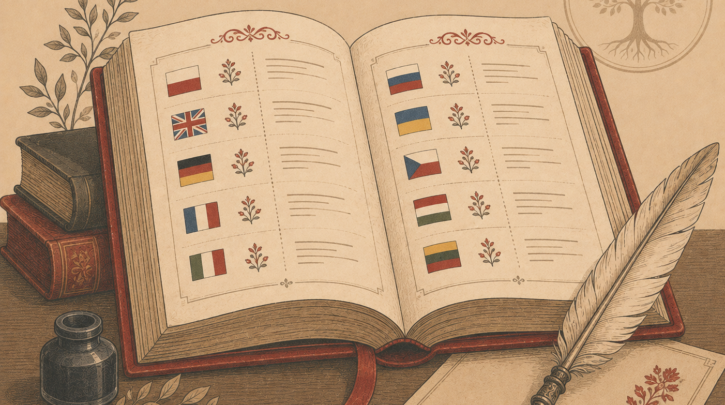
Posted on: May 8, 2026Polish Genealogy Glossary: Key Terms in Polish, Russian, Latin, and German
At some point in every Polish genealogy researcher’s journey, they encounter a word they don’t recognise in a record they desperately need to read. This glossary exists for exactly that moment. Polish genealogical records span four languages — Polish, Latin, Russian, and German — and…
Written by: Polish Roots Project (Editorial Team)
Posted on: May 8, 2026How to Read Old Polish Records (Including Russian and Latin Scripts)
The first time you open a 19th-century Polish church register and see pages of dense, faded handwriting in a script you don’t recognise, it’s easy to feel like you’ve hit an impenetrable wall. The good news is that you haven’t — what looks like an…