
Roughly 20 million people around the world identify as Polish by descent. The great-grandchildren of emigrants who left a century ago. Survivors of WWII who never went home. Children of Solidarity activists who fled martial law in the 1980s. And a new generation of economic migrants who left a democratic Poland in the 2000s for opportunities in Britain, Germany, and beyond. The Polish diaspora is one of the largest and most geographically dispersed in the world — and every family in it has its own version of the same question: why did they leave?
Understanding why your Polish ancestors left Poland — and what historical forces shaped that decision — transforms genealogy research from a hunt for names and dates into something closer to understanding a life. This guide traces the major waves of Polish emigration and the forces that drove each one, giving you the historical context to read your own family’s story within the larger story of the Polish diaspora.
Table of Contents
- The Great Emigration: Political Exiles After 1831 and 1863
- Za Chlebem: The Mass Economic Migration, 1880–1924
- Who Left and Why: The Economics of Emigration
- Where They Went: The Geography of the Polish Diaspora
- World War II and the Great Displacement
- The Cold War Diaspora: Refusing to Go Home
- Solidarity and the 1980s Wave
- EU Accession and the Modern Migration, 2004–Present
- Keeping Polish: How the Diaspora Maintained Identity
- Coming Home: The Return to Polish Roots
- Final Thoughts
The Great Emigration: Political Exiles After 1831 and 1863
The first significant modern wave of Polish emigration was political rather than economic. After the failed November Uprising of 1830–1831 against Russian rule, thousands of Polish intellectuals, military officers, and artists fled west — primarily to France, Britain, and Switzerland — rather than face imprisonment or death. This exile community, centred in Paris, included figures like the poet Adam Mickiewicz and the composer Frédéric Chopin. They called themselves the Wielka Emigracja — the Great Emigration — and they sustained Polish cultural and political life abroad for generations.
A second wave of political exiles followed the failed January Uprising of 1863 against Russian rule. These emigrants scattered across Western Europe and increasingly to North America. They were educated, politically engaged, and culturally Polish in ways that shaped the communities they joined. The distinction between these political emigrants and the later mass economic emigrants is significant for genealogical research: the political exiles left detailed records of their identities and activities in Western European archives.
Not sure where to start with your Polish ancestry?
Get the Polish Genealogy Quick-Start Checklist — a 6-step path to your first real ancestor record, plus the 5 terms you’ll see everywhere and direct links to the free archives you need. No subscription required.
Za Chlebem: The Mass Economic Migration, 1880–1924
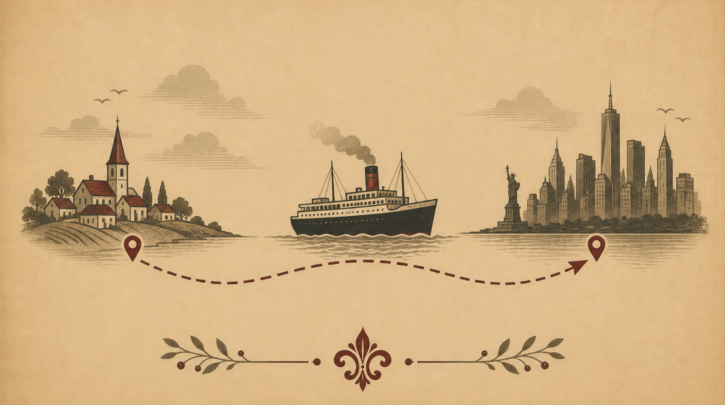
Za chlebem — “for bread” — is the phrase Poles used to describe the mass economic emigration of the late 19th and early 20th centuries. Between roughly 1880 and the US Immigration Act of 1924, which introduced strict national quotas, approximately 2–2.5 million Poles emigrated to the United States alone. Hundreds of thousands more went to Canada, Argentina, Brazil, Australia, and Western Europe. This is the emigration wave that produced most Polish-American, Polish-Canadian, and Polish-Australian families today.
The push factors were severe. Poland didn’t exist as an independent state — its territory was divided among Russia, Prussia, and Austria, each running the region for the benefit of the empire rather than the population. Land was scarce and getting scarcer as families subdivided holdings across generations. Rural overpopulation created genuine food insecurity in bad harvest years. And the Russian Empire’s Russification policies — suppressing Polish language and culture — added cultural and political pressure on top of the economic.
Who Left and Why: The Economics of Emigration
The emigrants of this era were overwhelmingly young, male, and from the peasant class — landless agricultural labourers or small landholders whose plots couldn’t support growing families. They came from specific regions in disproportionate numbers: from the Russian partition (particularly the Lublin, Kielce, and Radom gubernii), from eastern Galicia, and from the Prussian partition’s eastern districts.
Most emigrants did not initially intend to stay. They came as labour migrants — planning to earn enough to buy land or pay off debts back in Poland, then return. Estimates suggest 30–40% of Polish emigrants in this era did return. Those who stayed were often those who had established families, found stable employment, or found that Poland had changed too much during their absence to return to.
Chain migration was the dominant mechanism: a man emigrated first, found work and housing, then sent for brothers, cousins, and eventually his wife and children. This is why Polish immigrant communities in specific American cities often contain clusters of people from the same two or three villages — they followed each other along established routes.
Where They Went: The Geography of the Polish Diaspora
United States
The United States received the largest number of Polish emigrants. They concentrated in the industrial cities of the northeast and midwest — Chicago (which had the largest urban Polish population outside Warsaw), Pittsburgh, Buffalo, Detroit, Milwaukee, and the coal mining towns of Pennsylvania. Polish-American communities built churches, newspapers, schools, and cultural organisations that maintained Polish identity for generations.
Canada
Polish emigrants to Canada settled in two distinct patterns: urban communities in Toronto, Winnipeg, and Montreal, and agricultural settlers on the prairies of Manitoba, Saskatchewan, and Alberta — where land grants attracted families willing to farm the Canadian plains. Prairie Polish communities developed their own distinctive character, maintaining language and religion across isolated settlements.
South America
Brazil and Argentina received significant Polish emigration, primarily to agricultural settlements in the southern Brazilian states of Paraná, Rio Grande do Sul, and Santa Catarina. Polish communities in Brazil maintained Polish language and identity with remarkable persistence; some third-generation Brazilian descendants still speak a form of Polish at home today.
Australia
Polish emigration to Australia came in two main waves: a small pre-war trickle and a much larger post-WWII immigration of displaced persons who chose Australia over return to communist Poland. Australian Polish communities are concentrated in Melbourne, Sydney, and Adelaide.
World War II and the Great Displacement
World War II created the most traumatic and complex displacement in Polish history. Within six years, millions of Polish citizens were killed, deported, enslaved, or displaced by two totalitarian powers operating on Polish soil simultaneously. When the war ended, Poland’s borders had moved dramatically westward, its Jewish population had been almost entirely murdered, and approximately 1 million Poles found themselves in western Germany and Austria as displaced persons who refused to return to a Soviet-dominated homeland.
These post-war Polish DPs — former forced labourers, concentration camp survivors, Anders Army veterans, and political refugees — resettled primarily in Britain, the United States, Canada, and Australia. The Polish communities they founded tended to be more politically conscious and more explicitly anticommunist than the earlier economic emigrant communities, and they organised actively around Polish independence as well as cultural preservation.
The Cold War Diaspora: Refusing to Go Home
Throughout the communist period (1945–1989), a steady stream of Poles chose not to return to Poland after trips abroad, or found ways to emigrate legally or illegally. Athletes and artists who defected at international competitions, academics who stayed after foreign fellowships, and families who found ways through the increasingly porous borders of the 1970s and 1980s — all added to a diaspora that was growing even as emigration was officially restricted.
Solidarity and the 1980s Wave
The declaration of martial law in Poland in December 1981 — the communist government’s response to the Solidarity trade union movement — triggered the largest single wave of emigration since the immediate postwar period. An estimated 700,000–1 million Poles left in the 1980s, including many of Solidarity’s intellectual and activist leaders. This diaspora settled primarily in Western Europe, the United States, Canada, and Australia, and played a significant role in maintaining international pressure on the Polish communist government through the 1980s.
EU Accession and the Modern Migration, 2004–Present
Poland’s accession to the European Union in May 2004 opened the borders of most EU member states to Polish workers. Within two years, an estimated 1 million Poles had moved to the United Kingdom alone — the largest movement of people into Britain since the Huguenots. Germany, Ireland, the Netherlands, and Scandinavia received similar waves of Polish economic migrants drawn by wage differentials and freedom of movement.
Unlike earlier mass emigrations, this wave consisted largely of educated young Poles who often maintained close ties with Poland — returning for holidays, sending remittances, and in many cases eventually returning permanently. Brexit interrupted established patterns for Polish communities in Britain; some returned to Poland, others remained and applied for settled status.
Keeping Polish: How the Diaspora Maintained Identity
Across all these waves, Polish diaspora communities developed institutions that maintained cultural identity across generations: Polish Catholic parishes (where Polish-language Mass was said long after the congregation had shifted to English), Polish schools teaching language and history to second-generation children, Polish community clubs and fraternal organisations, and Polish-language press. The Polish National Alliance, the Polish Roman Catholic Union of America, and dozens of regional organisations created the infrastructure of a people maintaining themselves as a community across an ocean.
That infrastructure is why Polish heritage is traceable and recoverable today — because the community worked to preserve it, and because the records those institutions created survive in archives across the diaspora world.
Coming Home: The Return to Polish Roots
The most recent chapter of the Polish diaspora story is perhaps the most remarkable: the mass return to Polish roots underway since Poland joined the EU and particularly since the expansion of Polish citizenship by descent claims. Hundreds of thousands of people who identify as Polish by heritage are now researching their ancestry, claiming citizenship, visiting ancestral villages, and reconnecting with a country they’ve never lived in but feel deeply connected to.
This return is happening in genealogy databases, in Polish consulates around the world, in the archives of Polish villages, and in the living rooms of distant relatives being contacted for the first time. It’s one of the most significant identity movements of the 21st century — and it’s what brings most readers to Polish Roots Project.
Not sure where to start with your Polish ancestry?
Get the Polish Genealogy Quick-Start Checklist — a 6-step path to your first real ancestor record, plus the 5 terms you’ll see everywhere and direct links to the free archives you need. No subscription required.
Final Thoughts
Your family’s emigration story is one thread in this much larger tapestry. Whether your ancestors left for bread, for survival, for freedom, or for opportunity — their departure was shaped by forces larger than any individual decision, and understanding those forces makes their choices legible in ways that surname searches and vital records alone cannot provide.
Knowing why they left also contextualises what they left behind — the community, the culture, the language, the landscape — and what it means to reconnect with it now. Read our guide on what it means to reclaim your Polish heritage, or start your genealogy journey with our Complete Beginner’s Guide to Polish ancestry research. Subscribe to our newsletter for weekly Polish heritage guides.