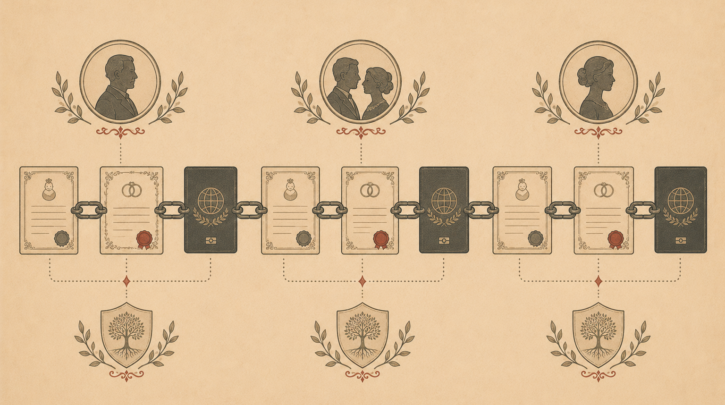

Somewhere in a Polish archive, a handwritten record exists with your family’s name in it. It might be a birth certificate from the 1880s, a marriage entry written in a priest’s careful cursive, or a parish baptismal register that no one in your family has seen in over a hundred years. That document — and the citizenship law built around it — may entitle you to a Polish passport today.
Polish citizenship by descent is one of the more remarkable provisions in European nationality law. Unlike countries that cap eligibility at one or two generations, Poland’s legal framework can extend the right to claim citizenship across multiple generations of descendants — provided the chain of citizenship was never legally broken. If your great-grandparents were Polish citizens when they emigrated, and if certain events didn’t sever that status under Polish law, there’s a genuine possibility that citizenship has passed through your family line without interruption.
This guide covers everything you need to understand about claiming Polish citizenship through ancestry: who qualifies, how the process works, what documents you’ll need, and what to realistically expect at every stage. Whether you’re at the very beginning of this journey or already neck-deep in paperwork, consider this your complete roadmap.
Table of Contents
- The Legal Foundation: Understanding How This Works
- Who Qualifies for Polish Citizenship by Descent?
- The Application Process: Step by Step
- Documents You’ll Need
- Where to Submit Your Application
- Timelines and Realistic Expectations
- Polish Dual Citizenship: Can You Keep Your Current Passport?
- Common Questions and Stumbling Blocks
- Final Thoughts
The Legal Foundation: Understanding How This Works
Poland operates on a principle known as continuous citizenship (ciągłość obywatelstwa). In practical terms, this means that if your ancestor held Polish citizenship at a specific point in time and never lost it under Polish law, that citizenship may have passed automatically to their descendants — including you.
This is fundamentally different from countries where citizenship lapses if you live abroad or don’t actively maintain it. Polish citizenship, within this legal framework, can persist through generations even if the family never returned to Poland and never thought of themselves as Polish citizens.
The Three Key Laws You Need to Know
Polish citizenship has been governed by a series of acts over the past century. Three matter most for descendants researching their eligibility.
The 1920 Polish Citizenship Act established the foundational rules for who was a Polish citizen following Poland’s re-emergence as an independent state after World War I. This law — and its interpretation by Polish courts — is central to most citizenship claims involving ancestors who emigrated in the early twentieth century.
The 1962 Polish Citizenship Act modified those rules and introduced clearer provisions around how citizenship could be lost — particularly through voluntary acquisition of foreign citizenship. For many descendants, this act is the pivotal document, because it governs the period when most Polish-born relatives were still alive.
The 2009 Polish Citizenship Act is the current operative law. It expanded protections for certain groups — particularly women and Jewish Poles who had been unfairly stripped of citizenship — and clarified how the confirmation process works. Most applications filed today are processed under this act.
Important: The specific act that governs your case depends on when your ancestor emigrated, when they may have naturalised elsewhere, and what events affected their citizenship status along the way. A qualified Polish citizenship lawyer can identify which law applies to your specific situation and what it means for your claim.
Confirmation vs. Grant: A Critical Distinction
This distinction trips up many first-time applicants. In Poland, you don’t apply for citizenship — you apply for confirmation that you already hold it.
The legal theory is that if the citizenship chain is unbroken, you are already a Polish citizen. The process is one of recognition, not award. This matters practically because it affects which authority handles your case, what evidence standard you must meet, and how the outcome is formally recorded.
Not sure where to start with your Polish ancestry?
Get the Polish Genealogy Quick-Start Checklist — a 6-step path to your first real ancestor record, plus the 5 terms you’ll see everywhere and direct links to the free archives you need. No subscription required.
Who Qualifies for Polish Citizenship by Descent?
The Generational Question
There’s no fixed number of generations back that Polish law covers. What matters is whether the citizenship chain is intact. In theory, you could be the great-great-grandchild of a Polish emigrant and still have a valid claim — but each generation adds complexity, because you need to demonstrate that no one in the chain took an action that terminated their Polish citizenship.
In practice, most successful claims trace back two to four generations: grandparents or great-grandparents who emigrated to the United States, Canada, the United Kingdom, Australia, or South America in the late nineteenth or early twentieth century.
The Citizenship Chain: What Can Break It
Several events can sever the citizenship chain — either for your ancestor or for a person in the line between your ancestor and you. The most common are:
- Voluntary naturalisation in another country before 1962 — Under the 1920 Act, acquiring foreign citizenship could extinguish Polish citizenship if done voluntarily. After 1962, the rules shifted: naturalisation abroad no longer automatically ended Polish citizenship.
- Formal renunciation of Polish citizenship — If an ancestor formally renounced their Polish citizenship through an official process, that ends the chain for themselves and potentially for children born afterward.
- Certain wartime decrees — Some Polish Jews and political opponents were stripped of citizenship by decree during the communist era. The 2009 Act addressed many of these cases, but the specifics matter enormously.
- Children born after citizenship was lost — If your ancestor lost Polish citizenship before your parent was born, your parent may not have inherited it — and neither would you.
Women’s Citizenship Before 1951
Before 1951, Polish law treated women’s citizenship as dependent on their husband’s. A woman who married a foreign national generally lost her Polish citizenship automatically upon marriage. This affects many family lines where the Polish ancestor is female and married in the late nineteenth or early twentieth century.
Post-1951, women’s citizenship became fully independent. If your Polish ancestor is a woman who married a non-Polish man before 1951, her own citizenship may have ended at marriage — but her children’s eligibility depends on your specific circumstances, not a blanket exclusion.
Note: This is one of the most misunderstood and most litigated areas of Polish citizenship law. The 2009 Act introduced corrective provisions, and court interpretations have evolved significantly. Don’t write off your claim based on this issue alone without proper legal review.
A Quick Eligibility Self-Check
Before diving into documents, work through these questions:
- Was your Polish ancestor born in Polish territory — or in territory that became part of independent Poland after 1918?
- Were they considered a Polish citizen at some point after Poland re-established itself in 1918?
- Did they voluntarily naturalise in another country, and if so, when?
- Did they ever formally renounce Polish citizenship?
- Are there any decrees or wartime events that may have affected their status?
If the answers suggest the chain may be intact, it’s worth proceeding. If you hit red flags at points 3 or 4, get qualified legal advice before investing heavily in document collection.
The Application Process: Step by Step
Step 1 — Map Your Family Chain
Before requesting a single document, do the research. Map your family tree from yourself back to your Polish ancestor, identifying every person in the direct line. For each person, note the country where they lived, approximately when they may have naturalised, and any events that might affect their citizenship status. The goal is to spot potential chain-breaking events before you’re buried in paperwork.
Step 2 — Gather Your Polish Records
Your application must establish a documentary chain connecting you to your Polish ancestor. For each person in that chain, you’ll typically need birth, marriage, and death certificates.
Polish vital records are held in several places depending on the era and region. Civil records from 1945 onward are held at local civil registry offices (Urząd Stanu Cywilnego). Older civil records and church (metrical) books are held at regional state archives — many are now accessible through Szukaj w Archiwach and the volunteer-indexed database Geneteka. Our guide to Polish genealogy research walks through the major archives and databases in detail.
Step 3 — Gather Foreign Records
For each person in your chain born or married outside Poland, you’ll need equivalent vital records from the relevant country — birth certificates, marriage certificates, death certificates, and naturalisation records.
Naturalisation records are particularly important. A certificate of naturalisation from the US, UK, Canada, or Australia establishes both when your ancestor naturalised and under what legal circumstances — which directly affects whether their Polish citizenship was terminated at that point.
Step 4 — Apostille and Translate Everything
Every foreign document submitted to Polish authorities must be officially certified under the Hague Convention (apostilled) by the issuing country’s competent authority, and then translated into Polish by a certified sworn (przysięgły) translator. Polish documents generally don’t require apostilles when used within Poland, but confirm current requirements with the consulate or voivode office handling your case.
Step 5 — Submit Your Application
You’ll submit your complete application either at a Polish consulate in your country of residence or directly at a voivode’s office (Urząd Wojewódzki) if you’re in Poland. More on which route to choose in the section below.
Step 6 — Wait, Track, and Follow Up
Polish citizenship confirmation can take anywhere from several months to several years depending on caseload, the complexity of your file, and where you applied. Keep copies of everything you submit. Follow up periodically and professionally. Patience isn’t optional — it’s part of the process.
Not sure where to start with your Polish ancestry?
Get the Polish Genealogy Quick-Start Checklist — a 6-step path to your first real ancestor record, plus the 5 terms you’ll see everywhere and direct links to the free archives you need. No subscription required.
Documents You’ll Need
No two cases require exactly the same documents, but the following gives you a solid baseline for what to expect.
For Your Polish Ancestor
- Birth certificate (Polish or translated equivalent)
- Marriage certificate (if applicable)
- Death certificate (if deceased)
- Any naturalisation records or records of renunciation
- Emigration records, passport records, or travel documents if available
For Every Person in the Chain Between Your Ancestor and You
- Birth certificate (establishing parentage)
- Marriage certificate (if the surname changed)
- Death certificate (if deceased)
- Naturalisation records for any country where they settled
For You (the Applicant)
- Your birth certificate
- Your current passport
- Your marriage certificate (if your surname has changed)
- Proof of current address
Practical tip: Always request certified copies of vital records rather than originals. Polish authorities expect certified copies, and you’ll want to retain originals in your own possession throughout the process.
When Records Are Missing or Destroyed
Significant portions of Polish records were destroyed during World War II — Warsaw alone lost an estimated 85–90% of its pre-war archives. This doesn’t necessarily end your claim.
When primary records are unavailable, applicants can sometimes substitute secondary evidence: emigration records, ship manifests, US census entries, draft registrations, or sworn family declarations. In some cases, a Polish court proceeding can legally establish facts that can’t be proven by surviving documents. An experienced Polish genealogist can often locate records you didn’t know existed — our Polish genealogy research hub has resources to help you start that search.
Where to Submit Your Application
Applying at a Polish Consulate Abroad
If you live outside Poland, the standard route is through the Polish consulate or embassy serving your area. The consulate receives your application and forwards it to a voivode in Poland, who makes the actual decision. Wait times at major consulates — particularly Chicago, New York, and London — have historically been long, sometimes stretching to several years. Check current wait times with your local consulate when planning your timeline.
Applying via a Voivode in Poland
If you’re living in Poland or willing to travel and stay for a period, you can submit directly to a regional voivode’s office. This route is often faster and allows you to interact directly with the authority making the decision. You’ll need to be physically present in Poland to submit, but subsequent steps may not require your presence.
Which Route Makes Sense for You?
For most people living abroad, the consular route is the practical default. If speed matters and you have the flexibility to spend time in Poland, applying directly to a voivode is worth serious consideration. The legal outcome and effect of both routes are identical — a confirmed Polish citizen is a confirmed Polish citizen regardless of where they applied.
Timelines and Realistic Expectations
Be honest with yourself before you begin: this process is slow, document-heavy, and occasionally unpredictable.
- Research and family mapping: 3–12 months, depending on what you already know and how much archive digging is required
- Document collection: 3–12 months for apostilles, sworn translations, and international records requests
- Application review: 6 months to 5+ years, depending on the authority’s current backlog and the complexity of your case
The total journey from starting your research to holding a formal confirmation of citizenship is typically 2–4 years for a reasonably straightforward case. Complex cases — those involving wartime records gaps, women’s citizenship issues, or ancestors who passed through multiple countries — often take longer.
Realistic mindset: This is a marathon, not a sprint. People who succeed tend to be methodical and patient. Set milestones for each stage, celebrate small wins like locating a key document, and resist the urge to rush a submission that isn’t complete.
Polish Dual Citizenship: Can You Keep Your Current Passport?
Poland does not require you to renounce your existing citizenship to hold Polish citizenship. Poland formally permits dual — and even multiple — nationality, meaning you can hold a Polish passport alongside your Australian, Canadian, British, or American one without legal conflict on the Polish side.
One important nuance: while Poland permits this, your current country of citizenship may have its own rules about acquiring foreign nationality. In most Western nations, acquiring Polish citizenship by descent (as distinct from naturalisation) does not trigger loss of your existing citizenship — but confirm this with your own country’s rules before proceeding.
Once confirmed, Polish citizenship entitles you to an EU passport, the right to live and work freely across all 27 EU member states, access to Polish public services and social systems, and the ability to pass citizenship to your children. For many descendants, that EU passport is the most immediately tangible benefit.
Common Questions and Stumbling Blocks
“My ancestor changed their name at immigration. Does that affect my claim?”
Name changes are common and rarely fatal to a claim. You’ll need to document the connection between the Polish name on original records and the anglicised name on later documents. Immigration records, naturalisation papers, and early census entries often capture both versions, which can bridge the gap effectively.
“My ancestor’s birth records were destroyed. Is my claim finished?”
Not necessarily. Alternative evidence can sometimes substitute for missing records, and Polish courts have established procedures for legally establishing facts when documentary proof is unavailable. This is where specialist legal guidance becomes particularly valuable — an experienced lawyer will know which secondary evidence pathways are accepted by which authorities.
“Can my children benefit from my Polish citizenship once it’s confirmed?”
Yes. Once you hold confirmed Polish citizenship, your children are generally entitled to Polish citizenship by descent from you — and they can apply for confirmation using the same process, with you (now a confirmed citizen) as their anchor. Children born after your confirmation are typically Polish citizens from birth.
“Does a DNA test help with my citizenship application?”
DNA evidence is not accepted as proof of ancestry for Polish citizenship purposes. What matters is the documentary chain, not genetic relationship. DNA testing is a powerful tool for genealogical research — and can genuinely help you find living relatives or confirm family connections — but it won’t substitute for vital records in a citizenship application.
Not sure where to start with your Polish ancestry?
Get the Polish Genealogy Quick-Start Checklist — a 6-step path to your first real ancestor record, plus the 5 terms you’ll see everywhere and direct links to the free archives you need. No subscription required.
Final Thoughts
Polish citizenship by descent is a genuine opportunity — one that connects you not just to a passport, but to a legal identity your ancestors carried and that survived wars, redrawn borders, and generations of distance. The process is demanding, but thousands of descendants complete it every year. What separates those who succeed from those who give up is almost never eligibility — it’s preparation, documentation, and persistence.
Start with your family research. Map the chain. Identify the gaps early. Get qualified legal advice before committing to a formal application, particularly if there’s any uncertainty about naturalisation history or citizenship-breaking events in your line. And treat each milestone — a found record, a translated document, a submitted form — as progress worth acknowledging.
Your next practical step is understanding exactly what documents you’ll need to gather. Head to our Citizenship by Descent hub for additional guides on documents, timelines, and finding specialist legal help — or subscribe to our newsletter for weekly Polish heritage guides delivered straight to your inbox.

I received my Kartka Polaka in August of 2024. My Grandfather came to America in 1911 and Grandmother and my one Aunt followed in August of 1913.
To the best of my knowledge neither of them ever renounced their Polish citizenship and were born in and on Polish Territory.
As mentioned, I do have my Kartka Polaka and it was issued from the Polish Consult in New York City.
Am I still eligible to obtain Polish Citizenship?
Hi Robert,
Thanks for sharing your story — this touches on one of the trickiest parts of Polish citizenship by descent: pre-1918 emigration.
Since your grandfather left in 1911 and your grandmother in 1913, they emigrated before Poland regained independence in 1918 and before the Citizenship Act of 1920 that created modern Polish citizenship. At that time, the territory they came from was part of the Russian, Austrian, or German partition — so where they were born doesn’t establish citizenship on its own. Eligibility generally depends on whether your ancestor was still living in Poland when the 1920 Act took effect (or otherwise formally recognized as a citizen), not just their birthplace.
Since it sounds like neither grandparent returned after emigrating, this isn’t automatically disqualifying, but it’s not a clear yes either — it needs a closer look at the specific dates and records.
One note on the Karta Polaka: it confirms Polish ethnic origin, not citizenship, so it doesn’t affect your eligibility either way.
Take a look at our full eligibility guide here for the details that matter most in cases like yours: https://polishrootsproject.com/polish-citizenship-eligibility/