
Most people who discover they might qualify for Polish citizenship feel a mix of excitement and uncertainty in equal measure. The legal framework sounds straightforward — citizenship passes through bloodlines — but the details are where most claims either hold up or fall apart.
Eligibility for Polish citizenship by descent isn’t determined by how Polish you feel, how many pierogies you’ve eaten, or whether you speak the language. It’s determined by a specific chain of legal events stretching back through your family history. Understanding that chain — and what can break it — is the first real step in figuring out whether you have a legitimate claim.
Table of Contents
- How Polish Citizenship Eligibility Actually Works
- How Many Generations Back Can You Claim?
- What Can Break the Citizenship Chain
- The Naturalisation Question: The Biggest Eligibility Factor
- Women’s Citizenship: A Complicated History
- Polish-Jewish Ancestry and Eligibility
- The Eligibility Self-Check: Walk Through Your Own Line
- What to Do If You Think You Qualify
- Final Thoughts
How Polish Citizenship Eligibility Actually Works
Poland uses a principle called ciągłość obywatelstwa — continuous citizenship. The idea is simple: if your ancestor held Polish citizenship and never legally lost it, that citizenship passed automatically to each subsequent generation. You don’t need to apply to become a Polish citizen — under this principle, you may already be one. What the application process actually does is confirm that the chain exists.
This matters because it shifts the question from “can I get Polish citizenship?” to “do I already have it?” Your job — and your lawyer’s job, if you engage one — is to demonstrate through documents that the chain has been unbroken from your Polish ancestor down to you.
Which Law Applies to Your Case?
Three major pieces of legislation govern Polish citizenship in the modern era: the 1920 Act, the 1962 Act, and the 2009 Act. Which one applies to your case depends largely on when your ancestor emigrated and when any citizenship-affecting events occurred. The Complete 2026 Guide to Polish Citizenship by Descent covers these three acts in full — understanding them matters, but for the purpose of assessing your eligibility, the key question is simpler: did anyone in your direct line voluntarily shed their Polish citizenship before you were born?
Not sure where to start with your Polish ancestry?
Get the Polish Genealogy Quick-Start Checklist — a 6-step path to your first real ancestor record, plus the 5 terms you’ll see everywhere and direct links to the free archives you need. No subscription required.
How Many Generations Back Can You Claim?
There is no fixed generational limit in Polish citizenship law. Theoretically, a fifth-generation descendant of a Polish emigrant could have an intact claim — if every person in the intervening generations passed the citizenship on without breaking the chain.
In practice, most successful claims involve ancestors who emigrated one to four generations ago. The further back your Polish ancestor, the more links in the chain you have to prove — and the more opportunities there are for a chain-breaking event to have occurred.
Practical reality: The most common successful claims come from people whose grandparents or great-grandparents emigrated from Poland between roughly 1880 and 1939. If your Polish connection is more recent — a parent or grandparent who came after World War II — your documentation challenge is usually simpler, though WWII-era displacement adds its own complications.
What Can Break the Citizenship Chain
This is where most people’s claims become complicated. The citizenship chain can be broken in several ways, and the effect is permanent — once someone in the line loses Polish citizenship, everyone born after that point doesn’t inherit it.
Voluntary Naturalisation (the Most Common Issue)
If your Polish ancestor or a family member in the direct line voluntarily became a citizen of another country, that act may have terminated their Polish citizenship — and the question of whether it did depends entirely on when it happened.
- Before 1962: Under the 1920 Act, voluntary naturalisation in a foreign country typically extinguished Polish citizenship. If your great-grandfather became an American citizen in 1928, his Polish citizenship very likely ended at that moment.
- After 1962: The 1962 Act changed the rules significantly. Naturalisation abroad no longer automatically ended Polish citizenship. From 1962 onward, a person could become a citizen of another country without losing their Polish citizenship — unless they actively renounced it.
The cut-off date of 1962 is one of the most important numbers in Polish citizenship research. Whether your ancestor naturalised before or after it can determine your entire eligibility.
Formal Renunciation
If an ancestor formally renounced Polish citizenship through an official government process — filing paperwork with Polish authorities and receiving confirmation — that ends the chain definitively for that person. Children born before the renunciation may still have inherited citizenship, but children born after typically did not.
Children Born After Citizenship Was Lost
If a parent lost Polish citizenship before a child was born, that child generally didn’t inherit Polish citizenship at birth. This is one of the more straightforward eligibility breakers — but it requires knowing exactly when the parent lost citizenship, which isn’t always clear from records.
Certain Wartime and Communist-Era Decrees
During the communist period, some groups — including political dissidents and many Polish Jews who emigrated — were stripped of citizenship by government decree. These cases are more complex and were partially addressed by the 2009 Act, which created pathways for descendants of people unlawfully stripped of citizenship. If your ancestors were affected by these decrees, the analysis is different and specialist legal advice is particularly important.
The Naturalisation Question: The Biggest Eligibility Factor
For the vast majority of descendants researching Polish citizenship, naturalisation is the central question. Here’s how to think through it.
Finding Out If Your Ancestor Naturalised
Naturalisation records for immigrants to the United States are among the most accessible in the world. The National Archives holds records going back to the late 1700s, and many are searchable online through Ancestry, FamilySearch, and Fold3. A naturalisation record typically shows the date of the oath, the country of origin, and sometimes the former nationality declared by the applicant.
For Canada, the UK, and Australia, naturalisation records are similarly available through national archives, though search access varies. For other countries, contact the relevant national archive directly.
When Naturalisation Doesn’t Break the Chain
Not every naturalisation ended Polish citizenship. Some key exceptions to be aware of:
- If naturalisation occurred after 1962, Polish citizenship was generally retained regardless
- Some pre-1962 naturalisations were not considered fully voluntary under Polish legal interpretation (particularly for those who naturalised under duress or to escape persecution)
- Children who were minors at the time of a parent’s naturalisation had their citizenship affected differently depending on which parent naturalised and the applicable law at the time
Women’s Citizenship: A Complicated History
Before 1951, Polish citizenship law treated women’s nationality as dependent on their husband’s. A Polish woman who married a foreign national automatically lost her Polish citizenship at the moment of marriage — regardless of whether she wanted to. This affects a significant number of family lines, particularly those where the Polish ancestor is female.
The Pre-1951 Marriage Rule
If your Polish female ancestor married a non-Polish man before 1951, her own Polish citizenship almost certainly ended at marriage. The critical question for your eligibility is: when were your parents or grandparents born relative to that marriage? Children born to this woman before her marriage retained different rights than children born after.
After 1951: Independent Citizenship
From 1951 onward, Polish women’s citizenship became fully independent of their husband’s nationality. A Polish woman who married a non-Polish man after 1951 retained her Polish citizenship, and that citizenship passed to her children regardless of the father’s nationality.
The 2009 Act Corrections
Recognising that the pre-1951 rule was discriminatory, the 2009 Act introduced some limited corrective measures. Some descendants who would have been excluded under the old rules now have viable pathways through legal channels. This is an evolving area of Polish citizenship law — if a female ancestor’s pre-1951 marriage is the stumbling block in your line, don’t assume the answer is automatically no.
Polish-Jewish Ancestry and Eligibility
Polish Jews who emigrated before, during, or after World War II — and their descendants — often face a distinct set of eligibility questions. Some Polish Jews were stripped of citizenship by communist-era decrees, particularly those who emigrated to Israel in the late 1940s and 1950s. Others left before the war and naturalised elsewhere early enough that the 1920 Act pre-1962 naturalisation rule applies.
There are also active legal debates about the rights of descendants of Jews who fled Nazi persecution — a group for whom “voluntary” naturalisation is a genuinely contested concept. Polish courts have issued varying decisions on these cases, and the law continues to develop. If your ancestry is Polish-Jewish, the eligibility analysis requires particular care and specialist legal input.
The Eligibility Self-Check: Walk Through Your Own Line
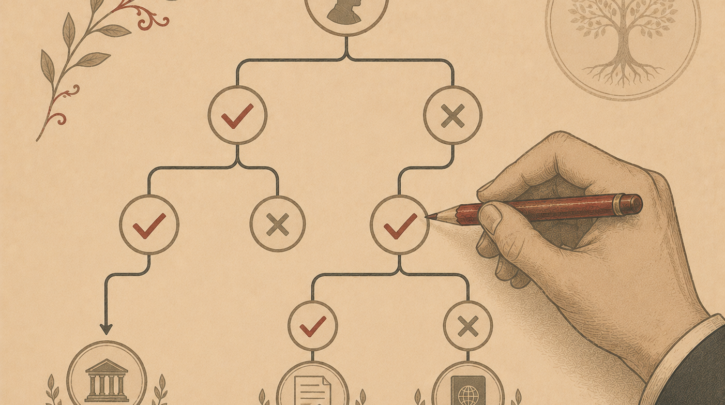
Use this structured process to do a preliminary assessment before engaging a lawyer or investing in documents.
- Identify your Polish ancestor. Where were they born? When? Were they in a territory that became part of Poland after 1918?
- Establish they were a Polish citizen. Were they born after 1918 in independent Poland? Did they live in a partition territory that became Polish? Do you have any evidence of their nationality?
- Check for naturalisation. Did this person become a citizen of another country, and if so, when? Before or after 1962?
- Check for renunciation. Did anyone in the line formally renounce Polish citizenship through an official process?
- Check for marriage (if the ancestor is female). Did she marry a non-Polish man, and if so, when — before or after 1951?
- Repeat for every generation between your Polish ancestor and yourself.
- Assess your own position. Were you born before or after any citizenship-affecting event in the line above you?
If you hit a confirmed chain-breaker — pre-1962 naturalisation, pre-1951 marriage to a foreigner, or formal renunciation — don’t stop immediately. The details matter. Was the naturalisation truly voluntary? Did the 2009 Act create a pathway? Could you qualify through a different line? These are questions for a specialist, not a checklist.
What to Do If You Think You Qualify
If your preliminary self-check suggests an intact chain, here’s how to move forward with confidence.
Start Gathering Documents
Begin collecting the vital records that document each link in the chain. Birth, marriage, and death certificates for every person in the line. Naturalisation records if applicable. The Citizenship by Descent hub has a full guide to exactly which documents you’ll need and where to find them.
Get a Legal Opinion
A qualified Polish citizenship lawyer can review your family line and give you a realistic assessment of your prospects before you commit to the full application process. Many offer initial consultations at a fixed fee. Given the time and cost involved in a full application, a legal opinion upfront is almost always worth the investment.
Don’t Write Off a Claim Based on Surface-Level Research
Many people dismiss their own claim too quickly — particularly those with female Polish ancestors or ancestors who naturalised. Polish citizenship law is nuanced, court interpretations have evolved, and the 2009 Act created pathways that didn’t exist before. If you’re on the fence, a legal consultation is far cheaper than assuming the answer is no.
Not sure where to start with your Polish ancestry?
Get the Polish Genealogy Quick-Start Checklist — a 6-step path to your first real ancestor record, plus the 5 terms you’ll see everywhere and direct links to the free archives you need. No subscription required.
Final Thoughts
Figuring out whether you’re eligible for Polish citizenship by descent is the most important step in the entire process — and it’s worth doing carefully. A claim built on a solid eligibility foundation moves through the application process with far fewer surprises. One built on assumptions tends to stall when a consulate asks a question the applicant wasn’t prepared for.
Take the time to map your family line, check for naturalisation records, and understand how the dates align with the key legislative thresholds. If the picture looks positive, the next step is understanding exactly what documents you’ll need to prove it. Subscribe to our newsletter for weekly Polish heritage guides, or head straight to our Complete 2026 Guide to Polish Citizenship by Descent for the full process walkthrough.