
If you’ve started researching Polish citizenship by descent, you’ve probably already come across timelines that range from eighteen months to five years — sometimes from the same source. That range isn’t evasion; it genuinely reflects how much variation exists in this process.
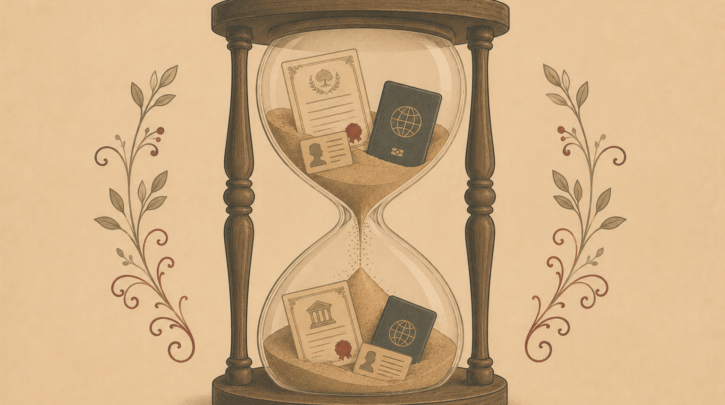
How long Polish citizenship by descent takes depends on several factors: how complete your family records are, where you apply, how busy the relevant authority is when your file lands, and how clean your case is once submitted. Understanding these variables — and what you can actually control — helps you plan realistically and avoid the frustration of treating someone else’s timeline as your own.
Table of Contents
- The Three Phases of the Process
- Phase 1: Research and Document Collection
- Phase 2: Document Preparation (Apostilles and Translations)
- Phase 3: Official Review by Polish Authorities
- Consulate vs. Voivode: Which Is Faster?
- What Affects Your Timeline?
- Common Causes of Delay and How to Avoid Them
- What a Realistic Full Timeline Looks Like
- Final Thoughts
The Three Phases of the Process
A Polish citizenship by descent application has three distinct phases, and each has its own timeline drivers. Conflating them — or assuming one person’s Phase 3 time applies to your Phase 1 — is the source of most timeline confusion.
- Phase 1 — Research and Document Collection: Locating, requesting, and receiving all vital records and supporting documents
- Phase 2 — Document Preparation: Obtaining apostilles and sworn Polish translations for each foreign document
- Phase 3 — Official Review: Submission to and processing by the Polish consulate or voivode
Phases 1 and 2 are largely within your control. Phase 3 is not — once you submit, you’re waiting.
Phase 1: Research and Document Collection
This is where most people underestimate the timeline. Locating records, requesting them from archives and vital records offices, and actually receiving them is rarely a quick process — especially for records held in multiple countries across multiple generations.
Typical Time: 3–18 Months
Where you land within that range depends heavily on how well-documented your family already is. If you have close relatives who’ve done genealogical research, if family members held onto original documents, or if your ancestors came from a region with well-preserved and digitised records, you might assemble the core documents in a few months. If you’re starting from scratch with an ancestor from a region with patchy records, expect closer to a year — or longer.
What Takes the Most Time
- Ordering vital records from Poland — USC offices in Poland can take weeks to months to respond to postal requests, particularly from abroad. Some regional archives have significant backlogs.
- US naturalisation records — Requests to the National Archives (NARA) for older naturalisation files can take 3–6 months for a response.
- Records from lesser-digitised regions — Polish records from areas that are now in Ukraine, Lithuania, or Belarus require more effort to locate and obtain.
- Locating the correct archive — If you don’t know exactly which village your ancestor came from, you’ll spend time narrowing that down before you can even identify the right archive. Our genealogy research guides cover the key databases and methods for finding an ancestor’s village.
Phase 2: Document Preparation (Apostilles and Translations)
Once you have your documents, every foreign-issued one needs an apostille from the issuing country and a sworn Polish translation. This phase is more predictable than Phase 1, but it still takes time — and it can be done in parallel with late-stage document collection.
Typical Time: 1–3 Months
Apostille processing times vary by country and by volume. In the United States, state Secretary of State offices typically process apostilles in one to four weeks; some offer expedited options for an additional fee. In the UK, the FCDO offers standard and premium services with different turnaround windows. Australian and Canadian equivalents are similarly tiered.
Sworn translations typically take a few days to a couple of weeks per document, depending on the translator’s workload and the complexity of the document. Batching documents with a single trusted translator — rather than spreading them across multiple providers — can speed this phase up and keep the quality consistent.
Phase 3: Official Review by Polish Authorities
This is the phase nobody can speed up. Once you’ve submitted your application — either at a Polish consulate or directly at a voivode office — you’re in the queue. Processing times are entirely determined by the authority’s current workload, staffing, and the complexity of your individual file.
Typical Time: 6 Months to 5+ Years
That range is genuinely as wide as it sounds. Simpler cases at less-busy voivode offices have been processed in under a year. Complex cases submitted through high-volume consulates — particularly Chicago and New York, which serve enormous Polish diaspora populations — have taken four or five years. The Polish government has made efforts to reduce backlogs, but processing times remain unpredictable.
After Submission: What Happens Inside
When you submit at a consulate, your file is forwarded to a Polish voivode for review. The voivode’s office reviews the documents, may request additional evidence if something is unclear, and ultimately issues the decision. If approved, you receive a potwierdzenie posiadania obywatelstwa polskiego — the official confirmation of Polish citizenship.
Important: If the voivode requests additional documents or information during review, responding promptly is critical. Delayed responses from applicants are a leading cause of extended processing times. Keep your contact information current with the relevant office throughout the waiting period.
Consulate vs. Voivode: Which Is Faster?
Applying directly to a voivode in Poland is generally faster than applying through a consulate. The consulate route adds an intermediary step — your file must travel from the consulate to a voivode before review begins — and consulates in high-demand cities (Chicago, London, New York) often have appointment backlogs that add months before you can even submit.
If you’re willing and able to travel to Poland and apply in person at a voivode office, you may be able to reduce Phase 3 time significantly. Some applicants have reported voivode processing times of 6–12 months, compared to 2–4 years through the consular route for equivalent cases. The tradeoff is the cost and practicality of being physically present in Poland at the time of submission.
What Affects Your Timeline?
Several factors either compress or extend each phase of the process:
Factors That Speed Things Up
- A recent generation of Polish ancestors (parents or grandparents), meaning fewer links in the chain
- Well-preserved records from a region with good archive access
- Applying directly to a voivode rather than through a consulate
- A clean, straightforward case with no naturalisation ambiguity or women’s citizenship issues
- Working with an experienced Polish genealogist or lawyer who knows how to anticipate what authorities will want
Factors That Slow Things Down
- Four or more generations back to the Polish ancestor
- Records from the former Kresy (eastern borderlands, now in Ukraine or Belarus)
- Warsaw-area ancestors (extensive archive destruction during WWII)
- Applying through a high-volume consulate in a major diaspora city
- Complex legal issues: pre-1962 naturalisation analysis, women’s citizenship questions, communist-era decrees
- Slow responses to requests for additional information from Polish authorities
Common Causes of Delay and How to Avoid Them
Incomplete Applications
The single biggest cause of delay is submitting an application before it’s genuinely ready. A missing document, an untranslated record, or an unapostilled certificate will stall your file until you provide what’s needed. Assemble the complete document set — and have a qualified lawyer review it — before submitting.
Incorrect or Outdated Contact Information
If the voivode sends a request for additional information and it bounces back or goes unanswered, your file goes to the back of the queue. Keep your contact details — particularly your postal address and email — updated with every authority involved in your case.
Not Using a Lawyer When the Case Is Complex
For straightforward cases with a clear documentary chain, applicants successfully navigate the process without legal help. For anything involving naturalisation date analysis, women’s citizenship issues, or missing records, not using a specialist significantly increases the risk of rejection or endless back-and-forth with authorities. The cost of a lawyer is almost always less than the cost of restarting a failed application.
What a Realistic Full Timeline Looks Like
Here’s what a reasonably straightforward three-generation claim typically looks like in practice:
- Months 1–3: Family research, identifying the ancestor and the records you need, ordering documents from Polish archives and US vital records offices
- Months 3–9: Receiving documents, chasing late arrivals, ordering naturalisation records from NARA
- Months 9–12: Apostilles and sworn translations, final review of the complete file
- Month 12–13: Consulate appointment obtained and application submitted (if applying via Chicago or New York, add 6–12 months to get an appointment)
- Months 13–36+: Official review period at the voivode level
Total: 2–4 years for a typical case through the consular route. Direct voivode applications tend to run 18 months to 3 years total.
A word on mindset: The applicants who find this process least stressful are those who treat it as a long-term project with milestones, not a transaction with a delivery date. Each document located, each record obtained, each translation completed is progress. Celebrate those wins rather than fixating on the end date.
Final Thoughts
Polish citizenship by descent takes as long as it takes — and that’s a genuinely variable answer depending on your specific circumstances. What you can control is how well-prepared your application is before it goes in, and how responsive you are during the review period. A complete, properly certified, professionally reviewed file simply moves more smoothly through the system than one thrown together quickly.
Start now. The sooner you begin gathering documents, the sooner your application clock starts. And the sooner it starts, the sooner you’re holding a Polish passport. See our Complete 2026 Guide to Polish Citizenship by Descent for the full process, or subscribe to our newsletter for weekly Polish heritage guides.