
Your Polish surname is a research tool as much as it is a name. Used correctly, it can narrow your search from all of Poland to a specific region, point you toward particular archive collections, and help you identify records you didn’t know to look for. Used incorrectly — or ignored — it leaves one of your best genealogical clues sitting unused.
This guide takes you through researching a Polish surname systematically: understanding what it means and what it’s made of, mapping its geographic distribution, searching the right databases, and using what you find to advance your broader family research. Whether you’re starting with a common surname like Kowalski or a rare one that appears in only a handful of parishes, the methodology is the same.
Table of Contents
- Step 1: Identify the Correct Polish Spelling
- Step 2: Understand the Surname’s Structure and Meaning
- Step 3: Map the Surname’s Geographic Distribution
- Step 4: Search Geneteka for the Surname
- Step 5: Check Heraldic and Noble Surname Dictionaries
- Step 6: Search JRI-Poland for Jewish Surname Variants
- Step 7: Look for the Surname in Immigration Records
- Step 8: Use DNA Matching to Connect With Surname Researchers
- Step 9: Join Surname Research Networks
- Step 10: From Surname Research to Village Research
- Final Thoughts
Step 1: Identify the Correct Polish Spelling
Before you can research a Polish surname effectively, you need the correct Polish spelling — not the anglicised version that may be in your family’s American, British, or Australian records. Polish orthography uses characters that don’t exist in English (ą, ć, ę, ł, ń, ó, ś, ź, ż), and these can be significant: Łukasz and Lukasz are different names; Różański and Rozanski index to different database entries.
Sources for the original Polish spelling include: ship passenger manifests (prepared from original documents), naturalisation petitions (which asked for original birthplace and name), early census records (sometimes captured the original spelling), and Polish vital records if you’ve already located them. Our guide to how Polish surnames changed at immigration covers the phonetic transformation patterns that help you work backward from an anglicised form to the likely Polish original.
Not sure where to start with your Polish ancestry?
Get the Polish Genealogy Quick-Start Checklist — a 6-step path to your first real ancestor record, plus the 5 terms you’ll see everywhere and direct links to the free archives you need. No subscription required.
Step 2: Understand the Surname’s Structure and Meaning
Once you have the correct Polish spelling, analyse the surname’s structure. What suffix does it carry? Is it -ski (adjectival, possibly toponymic), -wicz (patronymic), -czyk (diminutive patronymic), -ak/-iak (central Polish patronymic)? What is the root before the suffix? Is the root a common Polish word — a craft, a geographic feature, a plant or animal, a given name?
These questions often answer themselves once you look the root up in a Polish dictionary. Kowalski: kowal = blacksmith, -ski = adjectival suffix. Wiśniewski: wiśnia = cherry, -ewski = adjectival suffix indicating geographic origin. Knowing the meaning doesn’t tell you which Kowalski family is yours, but it tells you the type of origin to look for and often confirms or refutes geographic hypotheses. Our guide to Polish surname origins covers the full structural analysis in detail.
Step 3: Map the Surname’s Geographic Distribution
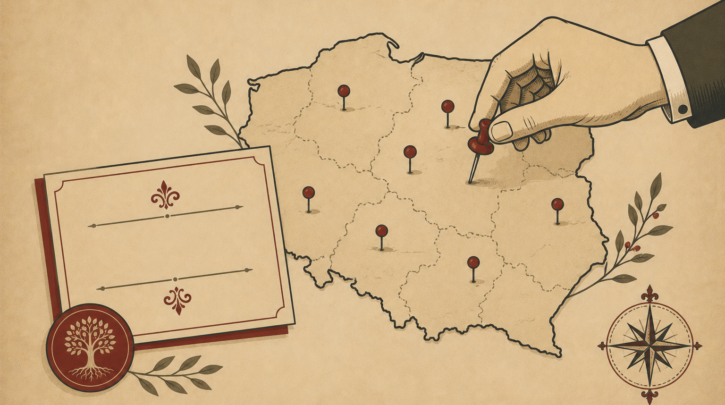
For toponymic surnames — those derived from place names — distribution mapping can dramatically narrow your geographic search. If a surname is concentrated in one or two voivodeships, there’s a strong probability your family originated in that region, because the place name that generated the surname is there.
Key tools for Polish surname distribution mapping:
- Moikrewni (moikrewni.pl) — provides Polish surname frequency maps at the powiat (county) level, showing exactly where in Poland each surname is most common today
- Forebears (forebears.io) — global surname distribution including Poland, with regional breakdowns
- Słownik nazwisk współczesnych Polaków — the Dictionary of Contemporary Polish Surnames, a reference work listing surname frequencies by region
For common surnames (Kowalski, Nowak), distribution is too even to provide geographic guidance. For less common surnames — anything outside the top 500 or so — distribution mapping often reveals a clear regional concentration that points your research toward specific archives.
Step 4: Search Geneteka for the Surname
Geneteka is the first archive database to search for any Polish surname. Use the phonetic search option (Fonetycznie checkbox) to catch spelling variants automatically. Search by region if you have geographic hypotheses from Step 3; search nationally if you don’t yet know the region.
Pay attention to geographic clustering in the results — if most Geneteka hits for your surname come from parishes in one or two regions, that’s a strong signal about geographic origin. Also search for the feminine form of the surname separately (Kowalska not just Kowalski) to ensure you’re capturing female-line records. Our full guide to how to use Geneteka covers advanced search techniques.
Step 5: Check Heraldic and Noble Surname Dictionaries
If your surname ends in -ski, -cki, or -zki, it’s worth checking Polish heraldic dictionaries (herbarze) to see whether the name appears as a noble surname and if so, what geographic origin and heraldic clan is associated with it. The Niesiecki Herbarz, the Boniecki Armorial, and the Wielka Genealogia Minakowskiego (wielcy.pl) are the primary resources.
Even if your specific family was not noble, heraldic dictionaries often identify the geographic region associated with the surname’s origin — because noble surnames typically derived from specific estates whose locations are documented. This geographic information can apply to non-noble families from the same area who adopted the same surname.
Step 6: Search JRI-Poland for Jewish Surname Variants
If your Polish family may have been Jewish, JRI-Poland should be part of your surname research. Jewish vital records were indexed separately from Catholic records in most regions, and JRI-Poland’s focus on Jewish community records means it catches records that Geneteka might miss for Jewish families. Search using Daitch-Mokotoff Soundex to find variant spellings of the same name across both Yiddish/Hebrew and Polish/Russian transcription systems.
Step 7: Look for the Surname in Immigration Records
Immigration records — ship manifests, naturalisation petitions, border crossing records — are particularly valuable for surname research because they often recorded the original Polish spelling of a name that was later anglicised. Searching Ancestry, FamilySearch, and the Ellis Island database for your surname (in all variant spellings you’ve identified) can surface family members you didn’t know about and provide geographic origin information.
The “last permanent residence” and “nearest relative in home country” fields in post-1906 US ship manifests are particularly useful — they often give village-level geographic information that connects the surname to a specific Polish community.
Step 8: Use DNA Matching to Connect With Surname Researchers
DNA testing can connect you with other descendants sharing the same Polish ancestry, some of whom may have already done extensive research on the same family line. When reviewing your DNA matches on AncestryDNA, 23andMe, or MyHeritage, filter for matches who share your Polish surname or have Polish ancestry in their family trees. Reaching out to these matches can provide access to research already done — shortcutting years of independent archive work.
Y-DNA testing (for men) is particularly useful for tracing a specific patrilineal surname line, and several Polish surname DNA projects on FamilyTreeDNA group researchers by surname for collaborative research.
Step 9: Join Surname Research Networks
Polish genealogy has active researcher communities where surname-specific knowledge is shared freely. The JewishGen Family Finder (for Jewish surnames), the Polish Genealogical Society of America’s surname registry, and Facebook groups like “Polish Genealogy” and “Polska Genealogia” all have active members who may be researching the same name. Registering your surname and family origin in these networks costs nothing and can result in contact from a previously unknown cousin who has already located the Polish records you’re looking for.
Step 10: From Surname Research to Village Research
Surname research is a means to an end, not the end itself. The goal is to use what the surname tells you — about geographic distribution, linguistic origin, and social class — to narrow your search down to the village or parish where your specific family can be found in vital records.
Once the surname research has given you a geographic hypothesis (or confirmed a geographic hypothesis you already had), move to village-level research: identify the relevant parish or civil registration district, search Geneteka for records from that community specifically, and work through the available records to find your direct line. Our guide to finding your ancestor’s village in Poland takes that next step in detail.
Not sure where to start with your Polish ancestry?
Get the Polish Genealogy Quick-Start Checklist — a 6-step path to your first real ancestor record, plus the 5 terms you’ll see everywhere and direct links to the free archives you need. No subscription required.
Final Thoughts
Surname research is one of the highest-leverage early steps in Polish genealogy — it costs nothing beyond time and can dramatically focus what would otherwise be an unfocused national search. The combination of structural analysis, distribution mapping, database searching, and community networking consistently produces geographic and genealogical leads that direct research toward productive archive targets.
Work through each step methodically. Note what you find and what hypotheses it supports. And when surname research has done its job — pointing you toward a region, a parish, a community — make the transition to vital records research and follow the family directly. For the full genealogy research framework, see our Complete Beginner’s Guide to Polish ancestry research. Subscribe to our newsletter for weekly Polish heritage guides.