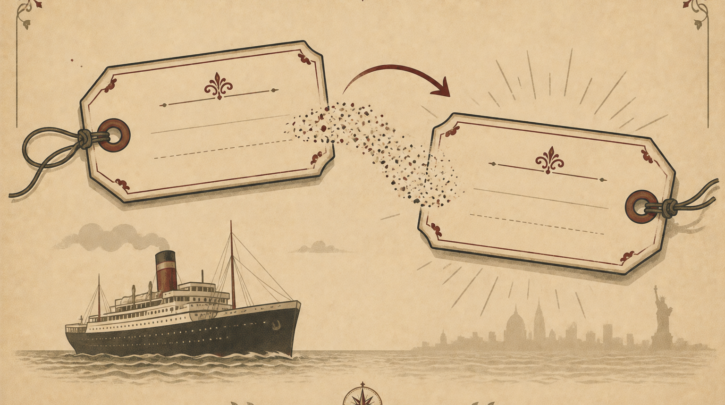

Somewhere between the gangway of a ship and the desk of an immigration official, many Polish surnames underwent their first transformation. By the time a family had lived in America for a generation, the name their great-grandparents had carried for centuries might be unrecognisable — shortened, respelled, translated, or replaced entirely.
Understanding how and why Polish surnames changed at immigration is one of the most practically useful skills in Polish-American genealogy. It’s the bridge between the American records you have and the Polish records you’re looking for. This guide covers every major pattern of Polish surname transformation — and gives you the tools to work backward from an anglicised name to its Polish original.
Table of Contents
- The Ellis Island Name Change Myth
- Why Polish Surnames Really Changed
- Dropping or Shortening -ski
- Phonetic Anglicisation
- Translating the Meaning
- Simplifying Consonant Clusters
- Complete Replacement With English Names
- Working Backward: From American to Polish
- Tools for Identifying the Original Polish Surname
- Final Thoughts
The Ellis Island Name Change Myth
One of the most persistent myths in American immigration history is that Ellis Island officials changed immigrants’ names — either through incompetence, impatience, or deliberate policy. It’s a compelling story, but it’s not how the system worked.
Ellis Island inspectors worked from passenger manifests that had already been prepared by shipping company clerks at the port of departure, typically in Hamburg, Bremen, Liverpool, or Trieste. The names on those manifests were transcribed from passports and ship tickets. By the time a passenger reached the Ellis Island inspection desk, their name was already recorded on a document the inspector was matching them to — not creating from scratch. Inspectors asked questions through interpreters; they didn’t invent new names.
Name changes happened — but they happened before Ellis Island (at the port of embarkation), after Ellis Island (when families settled and anglicised their names voluntarily), or at naturalisation (when some immigrants chose English names for their citizenship papers). The dramatic mid-processing name change is almost entirely fictional.
Why Polish Surnames Really Changed
The real drivers of Polish surname change in America were practical and social:
- Employer pressure — factory foremen, mine bosses, and other employers frequently couldn’t or wouldn’t use Polish names and assigned anglicised versions. Workers who wanted to keep their jobs adapted.
- Social pressure to assimilate — particularly from the 1910s onward as anti-immigrant sentiment rose, many Polish families chose to anglicise as a matter of survival and acceptance
- Spelling standardisation by American officials — clerks recording births, marriages, and deaths often spelled Polish names phonetically as they heard them, creating “official” anglicised versions that then became standard
- Children’s choice — many second-generation immigrants changed their own names when they came of age, preferring to sound American rather than Polish
- Naturalisation — the naturalisation process provided a formal legal opportunity to change one’s name, and many immigrants took it
Dropping or Shortening -ski
The simplest and most common transformation was dropping the -ski (or -ska, -cki, -zki) ending entirely, or shortening the name to just the root. Kowalski → Kowal → Cowall or Cowall. Wiśniewski → Wiśnia → Wishnia or even Wishen. Jankowski → Janko → Yanko or Janke.
In some cases the -ski was retained but respelled phonetically: Kowalski → Kovalsky → Kovalski. In others, just the final syllable was dropped: Lewandowski → Lewando → Levando. The result is often a fragment that sounds somewhat like the original but has lost the grammatical ending that makes it recognisably Polish.
Phonetic Anglicisation
Polish has several sounds that don’t exist in English, and English speakers rendered them as best they could in familiar letters. Key sound-substitution patterns:
- sz → sh: Szczepański → Shchepanski → Sheppanski → Shepanski
- cz → ch or tz: Czajkowski → Chaikovsky (or Chaikovsky → Kaykowski in some dialects)
- ź / ż → z or j: Różański → Rozanski → Rosanski
- ł → l or w: Głowacki → Glowacki → Glowatsky
- ń → n: Zieliński → Zielinski (the nasal sound simply dropped)
- ą / ę → on or en: Dąbrowski → Dombrowski (the nasal vowel rendered as om/on)
- y → i: Przynski → Przynski → Prinskie
The Dąbrowski → Dombrowski transformation is particularly important to know — a huge number of Polish-Americans with the surname Dombrowski or Dombrowsky trace back to Dąbrowski, one of the most common Polish surnames.
Translating the Meaning
Some Polish immigrants — particularly those who arrived with occupational or descriptive surnames whose meaning they knew — simply translated the name into English. Kowal (blacksmith) became Smith. Krawiec (tailor) became Taylor. Biały (white) became White. Mały (small) became Small or Little. Czarny (black) became Black.
These translations are particularly difficult for genealogists to identify because the American name gives no phonetic clue to the Polish original. A Smith family that turns out to be Kowalski is only discoverable through immigration records, where the original name was recorded before anglicisation.
Simplifying Consonant Clusters
Polish is famous for its consonant clusters — combinations of consonants that are difficult for English speakers to pronounce. Surnames beginning with or containing Szcz-, Prz-, Skrz-, Chrz-, and similar clusters were often simplified dramatically. Szczepański → Stepanski → Stepan → Stevens. Przybyszewski → Pribish. Skrzypczak → Scripczak → Scrip.
The simplification is phonetically motivated: English speakers found ways to approximate the sound that were easier to spell and say, and those approximations became the family’s American name. Working backward from the simplified form requires knowing which consonant clusters were present in the original and how they were typically reduced.
Complete Replacement With English Names
Some families simply replaced their Polish surname with an English one that had no phonetic or semantic connection to the original. Wisniewski might become Wilson. Wojciechowski might become Woods. Przybyszewski might become Price. These cases are the hardest for genealogists to trace because there’s no linguistic clue connecting the American name to the Polish one.
The most reliable way to identify these complete replacements is through immigration records (ship manifests, naturalisation papers) from before the change occurred, or through obituaries in Polish-language community newspapers that might name the original Polish surname alongside the anglicised one.
Working Backward: From American to Polish
When you have an anglicised surname and need to find the Polish original, work through these steps systematically:
- Find the earliest American record — ship manifest, first census after arrival, naturalisation petition, or first marriage record. The older the record, the closer to the original Polish name it’s likely to be.
- Look for the ship manifest specifically — ship manifests from 1906 onward are the single best source for original Polish names, as they were typically prepared from the passenger’s own documents at the port of embarkation.
- Apply reverse phonetic rules — if the American name is Dombrowski, the Polish original is probably Dąbrowski. If it’s Stepanski, try Szczepański. Work through the known phonetic transformations backward.
- Try adding -ski, -cki, or -wicz to the American root — many anglicised names simply dropped the Polish suffix.
- Search naturalisation records — post-1906 naturalization petitions list the applicant’s exact birthplace and often their name in the original spelling.
- Check Polish-language newspapers — the Polish press in America published vital notices (births, marriages, deaths) and obituaries that often gave both the Polish and English names.
Tools for Identifying the Original Polish Surname
- Ellis Island Foundation database (libertyellisfoundation.org) — search by approximate arrival date and name variant
- Ancestry’s ship manifest collection — the largest indexed collection of US immigration records
- FamilySearch naturalisation index — covers federal and many state naturalisations
- Chronicling America (Library of Congress) — digitised Polish-language American newspapers with searchable text
- Geneteka phonetic search — once you have a candidate Polish surname, phonetic search finds spelling variants in the archive index
- The Polish Surname Generator (online tool) — generates likely Polish originals from anglicised forms based on known transformation patterns
Final Thoughts
Polish surname transformation at immigration is one of the central puzzles of Polish-American genealogy — and one of the most solvable, once you understand the patterns. The original Polish name is almost always recoverable from records created before or shortly after the change, if you know where to look.
Find the earliest American record you can, work backward through immigration documents, and apply the phonetic transformation rules in reverse. The Polish original is usually hiding within the anglicised version — you just need to know how to look for it. For the next step in your surname research, see our guide to researching your Polish surname step by step. Subscribe to our newsletter for weekly Polish heritage guides.