
Ask ten Polish genealogists what the most important thing a beginner needs to know is, and most of them will give you the same answer: find out which partition your ancestor came from. That single piece of context changes everything — the language of the records, the archive that holds them, the databases that index them, and the administrative systems that created them in the first place.
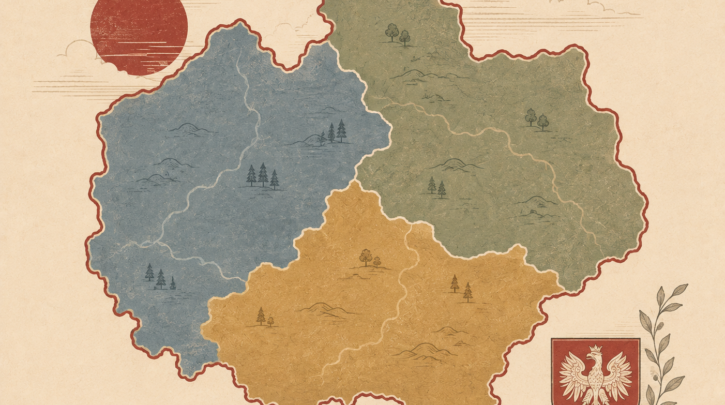
From 1795 to 1918, Poland ceased to exist as an independent state. Its territory was divided among three empires — Russia, Prussia, and Austria — each of which governed its portion under its own legal, administrative, and religious systems. The records that survive from those 123 years reflect those differences completely. Polish genealogy under the partitions isn’t one research challenge; it’s three, each requiring a different approach.
Table of Contents
- Why the Partition Zone Matters for Your Research
- How to Identify Which Partition Your Ancestor Came From
- The Russian Partition: Central Poland and the Congress Kingdom
- The Prussian Partition: Western Poland and Posen Province
- The Austrian Partition: Galicia and the South
- Border Regions and Overlaps
- After Independence: What Changed in 1918
- Final Thoughts
Why the Partition Zone Matters for Your Research
Each partition created its own record-keeping infrastructure — different languages, different administrative units, different record formats, and different archive systems. A birth record from a village in Russian-controlled Lublin looks completely different from one in Prussian Poznań or Austrian Kraków. The databases that index them are different. The archives that hold them are different. Even the names of the administrative units — gubernia, powiat, Kreis, Bezirk — require translation before you can navigate them.
Knowing the partition zone doesn’t just tell you where to look — it tells you what to expect when you get there. And that preparation dramatically reduces the frustration of searching the wrong databases, in the wrong language, for records that don’t exist in the place you’re looking.
Not sure where to start with your Polish ancestry?
Get the Polish Genealogy Quick-Start Checklist — a 6-step path to your first real ancestor record, plus the 5 terms you’ll see everywhere and direct links to the free archives you need. No subscription required.
How to Identify Which Partition Your Ancestor Came From
If you already know your ancestor’s village or town name, use a historical gazetteer or mapping tool to determine which empire controlled it before 1918. The Słownik Geograficzny Królestwa Polskiego (Geographic Dictionary of the Kingdom of Poland) — available partially digitised online — is the definitive historical reference. For a quicker check, search the village name in the Kartenmeister gazetteer or on JRI-Poland’s community locator, which often tags communities with their historical administrative region.
If you don’t yet know the village, the partition zone may still be inferable from other clues. Immigration records often list the ancestral country as “Russian Poland,” “Austrian Poland,” or “German Poland” — a rough but useful indicator. Ship manifests from the 1890s–1910s sometimes use the partition designation directly. See our Complete Beginner’s Guide to Polish ancestry research for more on finding village-level information from immigration records.
The Russian Partition: Central Poland and the Congress Kingdom
The Russian partition — formally called the Kingdom of Poland or Congress Kingdom — was the largest of the three zones, covering the heartland of central Poland including Warsaw, Łódź, Lublin, Kielce, Radom, and Siedlce. It’s also the zone with the most complex genealogical landscape, partly because of its size and partly because of the administrative changes Russia imposed over the 19th century.
Record Types and Languages
Civil registration began in the Russian partition around 1808 under Napoleon’s influence, using a dual-column Latin/Polish format. From around 1826 the format shifted to Polish only. After the failed 1863 uprising, Russia imposed Russification: from 1868, vital records were kept in Russian and written in Cyrillic script. This continued until Polish independence in 1918. The result is that records from the same parish can run through three or four different language systems depending on the decade — Latin, Polish, then Russian.
Where Records Are Held
Post-1945 civil records (from the USC offices) are held locally. Pre-war civil and church records are distributed across Poland’s state archive network — primarily the regional archives in Warsaw, Łódź, Lublin, Kielce, Radom, and Siedlce. A large and growing portion has been scanned and is accessible through Szukaj w Archiwach. Geneteka indexes many Russian-partition records by name, linking through to available scans.
Key Challenge: Warsaw Archive Losses
Warsaw’s archives suffered catastrophic WWII destruction — approximately 85–90% of pre-war civil records for the Warsaw area were destroyed. Researchers with Warsaw ancestors often need to rely on secondary sources: church records that survived separately, emigration records, community registrations, and records held at parish level rather than in the state archives.
The Prussian Partition: Western Poland and Posen Province
The Prussian partition covered western Poland — the Poznań region (then Posen Province), parts of Pomerania, Silesia, and areas around Bydgoszcz and Gdańsk. Prussia was administratively efficient, and that efficiency extended to its record-keeping. The civil registration system introduced in 1874 was thorough and well-maintained, and many records survived the 20th century in excellent condition.
Record Types and Languages
Pre-1874 records from the Prussian partition are primarily church registers, maintained in Latin or German depending on the denomination and era. Catholic parishes often kept Latin registers; Lutheran parishes kept German ones. From 1874, state civil registration standardised everything into German. Records are typically in German script, sometimes in the old Kurrent handwriting style that requires practice to read.
Key Databases for the Prussian Partition
Geneteka covers significant portions of the Prussian partition, particularly the Poznań region. The Poznan Project specialises in this zone — it has indexed 19th-century marriage records from the Poznań region with particular thoroughness, indexing all parties (groom, bride, parents, witnesses) making it excellent for tracing family networks. Some records from areas that remained in Germany after 1918 are held in German archives and may be accessible through Archion or Matricula portals.
The Austrian Partition: Galicia and the South
The Austrian partition — Galicia — is arguably the best-researched and most accessible zone for Polish genealogy. It covered southern Poland including Kraków, Rzeszów, Tarnów, Przemyśl, and Lwów (now Lviv, Ukraine). The Austrian administration was generally more tolerant of Polish language and culture than Russia, and the records reflect this: many Galician records are in Polish or Latin rather than an imposed imperial language.
Record Types and Languages
Church records in Galicia are primarily in Latin (Catholic) or the local vernacular for Greek Catholic and other communities. Civil registration began in 1784 but implementation was uneven; the system became more consistent through the 19th century. Austrian civil records are generally in Polish or German, sometimes both. The Greek Catholic (Uniate) community — concentrated in eastern Galicia — has its own distinct record series, often now held in Ukrainian archives in Lviv.
Key Databases for Galicia
Galicia is extremely well-served by online databases. Geneteka has enormous Galician coverage. The Metryki portal hosts scanned images of thousands of Galician parish registers. FamilySearch’s “Poland, Galicia, Roman Catholic Church Books” collection is one of the most-accessed genealogical databases in the world. For Jewish Galician research, JRI-Poland and JewishGen are the specialist sources.
Eastern Galicia: Now in Ukraine
Eastern Galicia — the area around Lwów/Lviv, Stanisławów/Ivano-Frankivsk, and Tarnopol/Ternopil — is now part of Ukraine. Records for this area may be held in Ukrainian state archives in Lviv, partly digitised through projects like the Central State Historical Archive of Ukraine. Access is more complex than for Polish-held records, though significant collections have been scanned and are accessible online.
Border Regions and Overlaps
The partition borders weren’t neat lines on the ground — they shifted over time, and some areas changed hands between empires. The Kresy (eastern borderlands) region is particularly complex: areas that were Polish between the wars (1918–1939) are now in Lithuania, Belarus, or Ukraine, and records are distributed across archives in Vilnius, Minsk, and Lviv as well as Polish state archives. Researching ancestors from these regions often requires working with multiple national archive systems simultaneously.
After Independence: What Changed in 1918
When Poland regained independence in 1918, it inherited three different civil registration and record-keeping systems — one from each partition zone. Standardisation took years. Through the interwar period (1918–1939), the language of record-keeping shifted to Polish across all formerly-partitioned territories, though the administrative structures and archive systems took longer to unify. Records from this period are generally more accessible than earlier ones, with most now held at local USC offices or state archives and well-represented in Geneteka.
Not sure where to start with your Polish ancestry?
Get the Polish Genealogy Quick-Start Checklist — a 6-step path to your first real ancestor record, plus the 5 terms you’ll see everywhere and direct links to the free archives you need. No subscription required.
Final Thoughts
Understanding the partition zone transforms Polish genealogy research from a general puzzle into a specific, targeted investigation. Once you know whether your ancestors came from the Russian, Prussian, or Austrian zone, you know which databases to prioritise, which archives to contact, and what language and script system to expect in the records you find.
The next practical step is getting into the databases themselves. Our guides on how to use Geneteka and how to use Metryki walk through the two most important free Polish research tools step by step. Or subscribe to our newsletter for weekly Polish heritage guides covering every corner of Polish ancestry research.