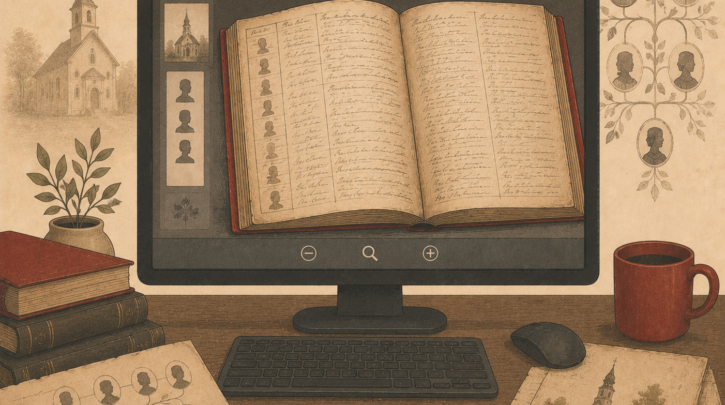

The handwriting is faded, the ink has bled into the page edges, and the Latin column headers look more like decoration than instruction. But somewhere in that scanned register image is your ancestor’s baptism record — written down the same week they were born, probably in a church that still stands in their home village today.
Metryki is the portal that gives you access to thousands of those images — scanned Polish church registers, available free online, covering hundreds of parishes primarily from the Galicia region and parts of central Poland. If Geneteka tells you a record exists, Metryki is often where you’ll go to actually see it. This guide explains how to navigate Metryki, find the right parish register, and extract the information you need from the records themselves.
Table of Contents
- What Is Metryki?
- What Records Does Metryki Hold?
- Navigating the Metryki Interface
- Finding the Right Parish and Record Set
- Browsing and Viewing Record Images
- Reading the Records: What to Expect
- Downloading and Citing Metryki Images
- When Your Record Isn’t on Metryki
- Final Thoughts
What Is Metryki?
Metryki (metryki.genealodzy.pl) is a free portal run by the Polish Genealogical Society that hosts scanned images of Polish church (metrical) records — baptism, marriage, and burial registers from Catholic parishes and some other denominations. Unlike Geneteka, which is a searchable index, Metryki is a browsable image archive: you navigate to the right parish and year, then scroll through the register pages to find your ancestor’s entry.
The portal is strongest for Galician (Austrian partition) records and for parts of the Mazovia and Łódź regions. Coverage is expanding as more scanning projects are completed and uploaded. The site is entirely free and requires no account to access images.
Not sure where to start with your Polish ancestry?
Get the Polish Genealogy Quick-Start Checklist — a 6-step path to your first real ancestor record, plus the 5 terms you’ll see everywhere and direct links to the free archives you need. No subscription required.
What Records Does Metryki Hold?
Metryki hosts scanned registers primarily covering the 18th through early 20th centuries. The core content is Roman Catholic parish registers (baptisms, marriages, burials), but some Greek Catholic, Lutheran, and Jewish civil records are also represented, depending on the region and the digitisation projects that have contributed to the portal.
Records are organised by parish and year range. Within a parish collection, you’ll typically find separate series for each record type — a baptism register covering 1826–1865, a marriage register for the same period, a burial register, and so on. Not every year in a series is necessarily complete; gaps exist where pages were lost or damaged.
Navigating the Metryki Interface
The Metryki homepage presents a map of Poland and a hierarchical menu. The navigation is in Polish, but follows a logical geographic hierarchy: region → diocese or archive → deanery → parish. Here’s how to work through it:
- Select your region — click on the relevant area of the map, or use the dropdown menu to select a modern voivodeship or historical region (Galicja, Mazowsze, etc.).
- Select the diocese or archive — records may be organised by the diocese that originally created them, or by the state archive that now holds them.
- Select the deanery (dekanat) — a grouping of parishes within a diocese.
- Select the parish — the specific parish whose registers you want to browse.
- Select the record series — choose births/baptisms, marriages, or deaths/burials, then the specific year range.
Tip: If you already have a Geneteka result and it links to a Metryki scan, you can skip the navigation entirely — just click the scan link in Geneteka and you’ll land directly on the right page in Metryki. Manual navigation is for when you’re browsing a parish systematically rather than following a specific lead.
Finding the Right Parish and Record Set
The trickiest part of using Metryki is often identifying which parish your ancestor belonged to. Catholic parishes in 19th-century Poland served specific geographic areas, and village boundaries changed over time. A village that was part of one parish in 1840 might have been transferred to another by 1880.
Several approaches help here. First, check whether a Geneteka index entry names the specific parish — that’s your most direct clue. Second, use the Kartenmeister gazetteer or the Słownik Geograficzny to identify the historical parish for a given village. Third, if you know the deanery, browse all parishes within it — neighbouring parishes often served overlapping village clusters, and some families used more than one parish over time.
Browsing and Viewing Record Images
Once you’ve selected a record series, Metryki presents a list of scanned pages (often thumbnails or a page-by-page navigator). Clicking a page loads the full-resolution scan. Most registers are organised chronologically within the year — January entries at the start, December at the end — so if you’re looking for a specific year and approximate month, you can navigate to roughly the right section of the register without reading every entry.
Records are typically laid out in a tabular format with column headers at the top of each page. In Latin records, the columns usually follow a standard sequence: record number, date, place of birth/marriage/burial, name of subject, names of parents or parties, names of witnesses, and officiating priest. Russian-format civil records follow a similar columnar structure but in Cyrillic.
Reading the Records: What to Expect
Reading a 19th-century Polish church register requires some preparation — but it’s a skill that develops quickly with practice. The key is recognising the structural pattern of the record format rather than trying to read every word from scratch each time.
Latin Records (Pre-1826 in most regions)
Latin baptism records typically include: record number, date, place, child’s name, legitimacy status, parents’ names (with mother’s maiden name), godparents’ names, and priest. A working vocabulary of around 50 Latin genealogical terms is enough to extract all essential information. Free Latin glossaries specifically for Polish genealogy are available from the Polish Genealogical Society of America and FamilySearch’s research wiki.
Polish-Language Records
Polish vital records from the 1808–1868 period in the Russian partition, and throughout the Austrian partition, are in Polish and follow standardised civil formats. These are often the most accessible records for researchers without specialist language skills — the format is familiar, the vocabulary is limited, and browser translation handles most of the reading work.
Russian Cyrillic Records
Post-1868 Russian partition records are in Russian and Cyrillic. The script looks formidable but is learnable — the genealogical vocabulary is standardised, and the columnar format means you need to recognise the same terms in the same positions across every record. Our full guide on reading old Polish records includes a Cyrillic primer specifically for vital records.
Downloading and Citing Metryki Images
Metryki images can be downloaded for personal research use using your browser’s standard image save function or the download option within the image viewer, where available. For a citizenship application, you’ll need a certified copy from the holding archive rather than a Metryki download — Metryki images are research copies, not legally certified documents. That said, a Metryki image is invaluable for identifying exactly which record number you need and which archive to contact for the certified copy.
When citing a Metryki record in your research notes, record: the parish name, record type, year range, page/scan number, and the URL. URLs in Metryki are persistent and can be used to return directly to a specific image.
When Your Record Isn’t on Metryki
Metryki’s coverage, while extensive, is far from complete. If the parish you need isn’t listed, or the specific years aren’t available, your options are:
- Check Szukaj w Archiwach — some records not on Metryki are available there
- Check FamilySearch’s Poland collection — their microfilming program captured many parish registers not available on Polish portals
- Contact the state archive directly — Polish state archives accept records requests by email or postal mail and can provide certified copies
- Contact the parish directly — some parishes retain their own registers and can respond to written requests
Not sure where to start with your Polish ancestry?
Get the Polish Genealogy Quick-Start Checklist — a 6-step path to your first real ancestor record, plus the 5 terms you’ll see everywhere and direct links to the free archives you need. No subscription required.
Final Thoughts
Metryki transforms Polish genealogy research by making original parish registers browsable from anywhere in the world. The learning curve — understanding the navigation, the record formats, the scripts — is real but manageable, and the reward is direct access to the handwritten records your ancestors appear in.
Use Geneteka to discover which records exist, and Metryki to actually read them. Together, these two free resources cover more Polish genealogical ground than any other combination of tools. Continue your research with our guide to the Polish state archives online, or head back to our Complete Beginner’s Guide for the full research framework. Subscribe to our newsletter for weekly Polish heritage research guides.