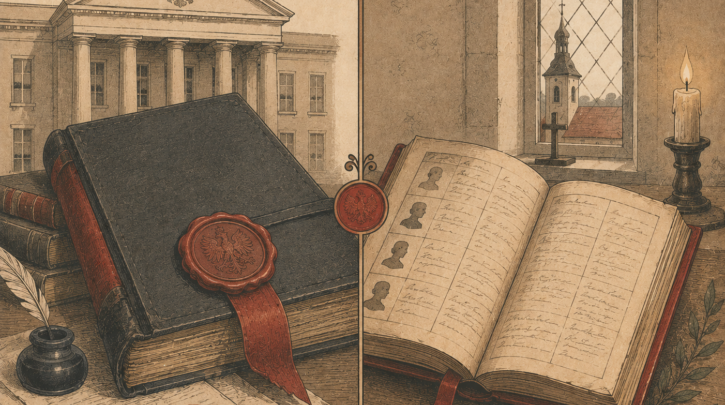

Two parallel record-keeping systems documented Polish lives for most of the 19th century — and knowing which one applies to your ancestor’s time and place is the difference between finding their records in minutes and spending hours searching the wrong archive.
Polish civil records and church records both recorded births, marriages, and deaths — but they were created by different authorities, in different languages, with different levels of detail, and are now held in different places. For anyone tracing Polish ancestry, understanding the distinction is foundational. This guide explains what each record type is, what it contains, where it’s held, and how to decide which one to search first.
Table of Contents
- What Are Polish Civil Records?
- What Are Polish Church Records?
- The Timeline: When Each System Applied
- Content Comparison: What Each Record Type Contains
- Language Differences
- Where Each Type Is Held Today
- Which Should You Search First?
- Using Both Types in a Citizenship Application
- Final Thoughts
What Are Polish Civil Records?
Civil records (also called state records or secular records) are vital records — births, marriages, deaths — created by a civil (government) authority rather than a religious institution. In Poland, state-supervised civil registration was introduced by different administrations at different times depending on which empire controlled the territory.
Civil records typically follow a standardised format set by the governing authority, were maintained in duplicate (one copy lodged with the local registrar, one sent to a central archive), and are generally considered more reliable than church records for genealogical purposes — partly because they were legally required and subject to official oversight, and partly because they tend to include more structured personal information.
What Are Polish Church Records?
Church records — also called metrical records or parish registers — are vital records created by religious institutions: Catholic parishes, Lutheran churches, Greek Catholic (Uniate) communities, Jewish kehilot, and others. Before civil registration arrived in a given region, parish registers were the only official record of a birth, marriage, or death. In some areas, parish registers predate civil registration by centuries.
The format of church records was set by the religious denomination rather than the state, and varies more than civil records. Catholic records often follow guidelines set by the Council of Trent (1545–1563), which standardised the information parishes were required to record. The quality and completeness of individual records depended heavily on the diligence of the priest or record-keeper.
The Timeline: When Each System Applied
The arrival of civil registration in Polish territories was gradual, uneven, and different in each partition zone:
- Russian partition: Civil registration introduced around 1808 under Napoleon’s civil code, using a dual Latin/Polish columnar format. Switched to Polish-only around 1826, then to Russian after the 1863 uprising (approximately 1868). Civil registration ran continuously until WWII and beyond.
- Prussian partition: State civil registration introduced in 1874, replacing the patchwork of church registers that had been the only official record until then. Records from 1874 are civil; earlier records are church registers.
- Austrian partition (Galicia): Civil registration began in principle from 1784 but implementation was inconsistent. For most Galician villages, church parish registers served as the de facto vital record through most of the 19th century. More formal civil registration became consistent from around the 1870s–1880s.
In practical terms: if your ancestor was born, married, or died before the civil registration threshold for their region, you’re looking for a church record. After that threshold, a civil record likely exists — and in some periods, both exist simultaneously.
Content Comparison: What Each Record Type Contains
Civil Birth Records
A standard 19th-century Polish civil birth record typically includes: record number, date and place of registration, names of parents (including mother’s maiden name), father’s occupation and place of residence, names and occupations of witnesses, and the child’s full name and sex. Some records also note the exact time of birth and the officiating registrar’s name. This is substantially more information than most church baptism records of the same era.
Church Baptism Records
A Catholic baptism record typically records: date of baptism (not always the birth date, though many priests noted both), child’s name, legitimacy status, parents’ names (with mother’s maiden name in later records), godparents’ names and sometimes their village of origin, and the priest’s name. The date of actual birth may appear as a marginal note or may be absent. Witness and godparent information can be genealogically valuable — godparents were often close relatives.
Marriage Records
Both civil and church marriage records from the 19th century tend to be the richest source of genealogical information — they typically record the ages (and sometimes birth dates and birthplaces) of both parties, their parents’ names, the marital status of each party, witnesses, and any declarations about prior marriages. Civil marriage records often include additional documentation, such as birth certificates submitted as part of the marriage process, which can provide access to records from another parish or district.
Language Differences
- Civil records — Russian partition: Latin/Polish dual format (1808–1826), Polish (1826–1868), Russian Cyrillic (1868–1918)
- Civil records — Prussian partition: German (from 1874)
- Civil records — Austrian partition: Polish or German, depending on era and district
- Church records — Catholic: Latin (through most of the 19th century), then Polish or the local vernacular in later decades
- Church records — Lutheran: German in Prussian partition; Polish or German in other zones
- Jewish records: Hebrew/Yiddish in older records; Russian, Polish, or German in civil registration depending on partition zone
Where Each Type Is Held Today
Civil Records
Post-1945 civil records are held at local civil registry offices (Urząd Stanu Cywilnego). Pre-war and 19th-century civil records have been transferred to Poland’s regional state archives (Archiwa Państwowe). A significant and growing portion is digitised and accessible through Szukaj w Archiwach. Many are also indexed in Geneteka.
Church Records
Older church registers are held at a mix of institutions: regional state archives (for records transferred from parishes), diocesan archives (for records retained by the church), and some individual parishes (for more recent registers). The Metryki portal hosts scanned images of many parish registers, and FamilySearch has microfilmed extensive collections of Polish parish records. Geneteka indexes many church records and links through to available scans.
Which Should You Search First?
The answer depends primarily on your ancestor’s time period and partition zone:
- If born after 1874 in the Prussian partition → start with civil records
- If born after 1808 in the Russian partition → civil records likely exist; check both
- If born in Galicia before the 1880s → church records are likely your primary source
- If you’re unsure of the date → start with Geneteka, which indexes both types and will show you what’s available
In many cases, both a civil record and a church baptism record exist for the same event — particularly in the early civil registration period, when church and state registration ran in parallel. When both are available, use both: they often contain complementary information.
Using Both Types in a Citizenship Application
For Polish citizenship applications, both civil records and church records are generally accepted as evidence — provided they are official certified copies rather than digital images or photocopies. Civil records tend to be preferred where available, as they are the official state record. Church records are accepted as alternatives when civil records don’t exist for the relevant period.
Our guide to Polish citizenship documents covers what format is required for each document type in a citizenship application, and how to request certified copies from the appropriate archive or office.
Final Thoughts
Civil records and church records aren’t competing systems — they’re complementary ones. Understanding which type is likely to exist for your ancestor’s time and place focuses your search and saves you from looking in the wrong place. And when both types are available, using them together gives you a richer, more complete picture of your ancestor’s life than either alone.
With this foundation in place, the next step is understanding how to access Poland’s digitised archive holdings directly. Our guide to the Polish state archives online covers what’s been digitised, how to navigate Szukaj w Archiwach, and how to request records that aren’t yet available digitally. Subscribe to our newsletter for weekly Polish heritage guides.