
One question comes up more than almost any other in our inbox: “My great-grandfather was Polish — am I too many generations removed to qualify?” The good news is that, unlike many other European citizenship-by-descent programs, Poland places no cap on the number of generations a citizenship claim can pass through. What matters isn’t how many generations separate you from your Polish ancestor — it’s whether the chain of citizenship between you and them was ever legally broken.
The core rule: jus sanguinis, without a generation limit
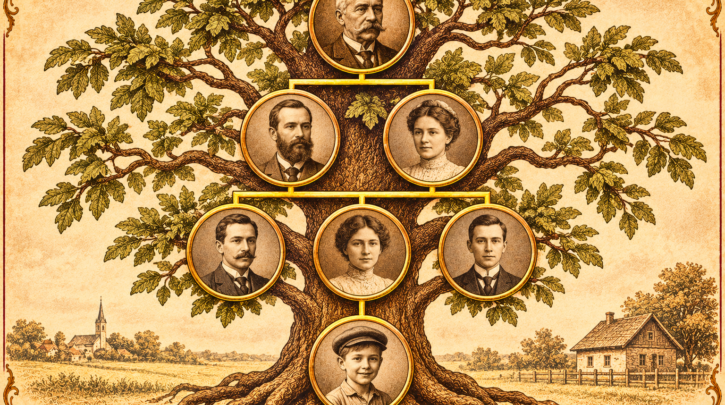
Polish citizenship law operates on the principle of jus sanguinis — “right of blood.” Citizenship passes automatically from a Polish-citizen parent to their child at the moment of birth, regardless of where that child is born. If your parent held Polish citizenship when you were born, you were born a Polish citizen too, whether or not anyone in the family realized it or ever used a Polish passport. Because this transmission happens at every generation, an unbroken chain can extend for as many generations as the documentation allows — great-grandchildren, great-great-grandchildren, and beyond.
This puts Poland in a more generous position than several comparable programs. Italy’s citizenship-by-descent law was tightened in 2025 to limit new claims to a parent or grandparent born in Italy, cutting off great-grandparent chains for new applicants. Ireland’s foreign-birth registration route generally reaches back to a grandparent. Poland’s approach has stayed rooted in the unbroken-chain principle rather than a fixed generational cutoff.
Does your line go back far enough?
Answer two quick questions to see whether your family line may qualify. Free, and it takes about 30 seconds.
Check my eligibility →So what actually breaks the chain?
Because there’s no generation cap, the entire question of eligibility comes down to one thing: did any ancestor in your direct line lose Polish citizenship before the next generation was born? If the answer is no at every link, the citizenship passed down automatically and you may already be a Polish citizen, whether or not you or your parents ever knew it. Common events that can break the chain include:
- Naturalizing as a citizen of another country before 1951, when Polish law of that era could treat foreign naturalization as an automatic loss of Polish citizenship in some circumstances
- Formally and voluntarily renouncing Polish citizenship with the consent of Polish authorities
- Service in a foreign military or foreign public office without the required permission, under laws that applied in specific historical periods
- For some emigrants between 1951 and 1962, administrative loss of citizenship applied retroactively by the Polish state — often without the person’s knowledge
This is why the research is often more involved than simply confirming an ancestor was born in Poland. You (or a Polish citizenship attorney) need to establish what your ancestor’s citizenship status was at each point a subsequent generation was born, based on the law in force at that specific time.
The 1920 starting point
Most descent claims trace back to Poland’s first modern citizenship act, which took effect on January 31, 1920, following the restoration of Polish independence in 1918. If your ancestor held Polish citizenship on or after that date, and the chain to you remained unbroken, that’s typically your foundation. Ancestors who emigrated before 1920 — a large share of the Polish-American emigration wave of the late 19th and early 20th centuries occurred before Poland formally existed as a state again — require closer analysis, since citizenship of the restored Polish state in 1920 depended on residency and other criteria at that moment, not simply ethnic or family origin. See our guide to the 1920 Citizenship Act for how this threshold works in practice.
What this looks like across generations
| Generation from Polish ancestor | Still eligible if chain unbroken? | What you’ll typically need |
|---|---|---|
| Grandchild | Yes | Grandparent’s Polish birth/citizenship record, parent’s birth record showing descent |
| Great-grandchild | Yes | Same, plus one additional generation of birth and marriage records |
| Great-great-grandchild | Yes, if documentable | Full unbroken paper trail across every intervening generation |
| Any generation | No, if chain was broken | Ineligible for descent claim regardless of generation count |
Confirmation, not application
It’s worth repeating a point that trips up a lot of first-time researchers: if your chain is unbroken, you’re not applying for Polish citizenship — you’re asking Polish authorities to confirm a citizenship you already legally hold. This distinction affects which procedure you use and what you’re proving. See our comparison of confirmation versus application for the practical difference.
Documents you’ll need for a multi-generation claim
The further back your qualifying ancestor sits, the more documents the chain requires — one full set of vital records per generation. At minimum, expect to gather:
- Your Polish ancestor’s Polish birth record (or equivalent proof of Polish citizenship at the relevant time)
- That ancestor’s emigration and any foreign naturalization records, to establish exactly when and whether they took on another citizenship
- Birth records for every generation in the direct line down to you, showing the parent-child relationship
- Marriage records where a name change occurred, particularly for female ancestors
- Your own birth certificate and, if applicable, current passport
Our full documents guide covers where to request each record type, including which come from Polish state archives versus U.S. and Canadian civil registries.
Building your document chain generation by generation? A free MyHeritage trial lets you search historical records and family trees for clues (affiliate link).
Special note for Polish-Jewish descendants
Chain-breaking events were disproportionately common for Polish-Jewish families who emigrated to escape persecution, and the documentary trail is frequently harder to reconstruct due to destroyed or dispersed records. If this applies to your family, our guide for Polish-Jewish descendants covers the additional considerations and alternative documentation strategies that specialist attorneys commonly use.
This article is for general informational purposes only and does not constitute legal advice. Polish citizenship law involves case-specific documentary requirements. For an individual eligibility assessment, consult a qualified Polish citizenship attorney or the nearest Polish consulate. Official guidance is available at gov.pl.
There is no generation cap on Polish citizenship by descent — there’s only the question of whether the chain to you was ever broken.
Common misconceptions about generational limits
A lot of confusion comes from applying rules for other countries’ programs to Poland by assumption. A few things worth clearing up directly:
- “Only grandparents count.” This is true for some countries (Ireland, for instance) but not for Poland — there is no cutoff generation written into Polish law.
- “If my ancestor left before I was born, the line is automatically broken.” Emigration alone doesn’t break citizenship. What matters is whether they formally naturalized elsewhere or lost citizenship under a specific legal provision in force at the time.
- “My family never used a Polish passport, so we can’t have kept citizenship.” Citizenship and passport usage are different things. Many families carried Polish citizenship for decades without ever applying for or using a Polish passport, simply because they lived their entire lives abroad.
Frequently asked questions
Does it matter which parent or grandparent was Polish?
Historically, Polish law before 1951 restricted citizenship transmission through the mother in certain circumstances when the father held a different citizenship. Post-1951 law and the current 2009 Citizenship Act treat transmission through either parent equally, but if your qualifying ancestor is several generations back, the rules in force at that specific point in time — not today’s rules — govern whether transmission occurred. This is one of the more nuanced areas where a citizenship attorney’s help is genuinely valuable.
Can I claim citizenship if my great-grandparent was born in a region that’s no longer part of Poland?
Potentially, but this depends heavily on the specific region, the date of birth, and whether your ancestor was a citizen of the restored Polish state after 1920 or of a different state (the Russian, German, or Austro-Hungarian empires) at the relevant time. Border changes after both World Wars make this one of the more research-intensive scenarios; see our guide on the three partitions for regional context.
How long does a multi-generation confirmation take?
Processing itself typically runs 9–18 months once a complete application is filed, but multi-generation claims often take considerably longer to prepare, since gathering and translating records across three or four generations and jurisdictions is usually the slowest part of the process. See our timeline guide for realistic planning expectations.
Where to start
If you’re unsure whether your family’s line stayed unbroken, start with our eligibility overview, then work backward generation by generation gathering documents. Given how research-intensive multi-generation claims can be, most descendants several generations removed from their Polish ancestor choose to work with a citizenship attorney who specializes in reconstructing these historical chains rather than attempting the archival research alone.