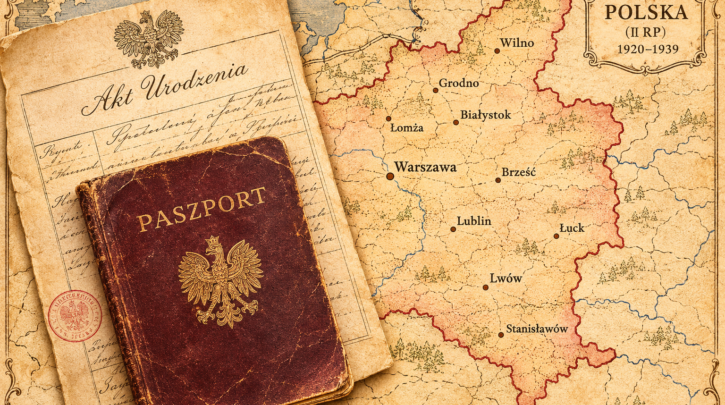

Many Americans of Polish descent have an ancestor who was born in Lwów, Wilno, Stanisławów or Grodno. Today those cities are in Ukraine, Lithuania and Belarus, and families often assume that makes their ancestor “not Polish.” Citizenship law does not work that way. What matters is the ancestor’s status at the relevant time, not the country on today’s map. This guide explains how the former eastern territories, the Kresy, fit into a Polish citizenship claim, and where the real obstacles are.
Important: This article is general information for educational purposes, not legal advice. Polish citizenship law is technical, depends on the facts of each family line, and is applied case by case by Polish authorities. Verify current requirements with the Polish consulate that serves you or the Polish government’s official citizenship pages, and consider consulting a qualified Polish citizenship lawyer before filing anything.
Table of Contents
- Why “where was he born?” is the wrong first question
- Interwar Poland and the Kresy
- The partition you came from still matters
- What 1945 changed, and what it did not
- Where the records are now
- A worked example
- Next steps
Why “where was he born?” is the wrong first question
Poland’s borders moved dramatically in the twentieth century. Places that were part of the Polish Republic between the world wars are now outside Poland, and most of the records for them are held in other countries. Two different questions tend to get mixed up. One is a legal question: was your ancestor a Polish citizen when the chain was supposed to pass down? The other is a records question: where are the documents that prove it? A birthplace in what is now Ukraine makes the second question harder. It does not, by itself, answer the first.
Born in Lwów or Wilno? Check your line.
Answer two quick questions to see whether your family line may qualify. Free, and it takes about 30 seconds.
Check my eligibility →Interwar Poland and the Kresy
Between 1920 and 1939, cities such as Lwów and Wilno, and regions such as Nowogródek and Polesie, were part of Poland. An ancestor who was born in one of those territories and lived there after the 1920 Citizenship Act took effect can in principle qualify as a Polish citizen like anyone born in Warsaw or Kraków. Our guide to the 1920 Polish Citizenship Act explains how that Act worked, and our overview of researching ancestors from the Kresy covers the genealogy side.
In practice, proof usually depends on registration. Polish officials have said that entries in the permanent residence registers are the basis of assessment for many people, and that someone found in those registers with no other citizenship shown was most likely a Polish citizen. Where those registers did not survive, which is common for western Ukraine, other documents can fill the gap: voting registers, civil records, army records and the surviving “Beyond the Bug River” archives.
Not sure where to start with your Polish ancestry?
Get the Polish Genealogy Quick-Start Checklist — a 6-step path to your first real ancestor record, plus the 5 terms you’ll see everywhere and direct links to the free archives you need. No subscription required.
The partition you came from still matters
The territory your ancestor came from was part of Russia, Austria-Hungary or Prussia before 1918, and the route to Polish citizenship differed by partition. Ancestors from the former Russian partition, which includes Wilno and much of the east, may be affected by the Treaty of Riga of 1921, which set conditions for citizenship after the Polish–Soviet border was fixed. Commentators summarize those conditions as requiring registration and other criteria met by 30 April 1921. Ancestors from the former Austrian partition, including Galicia and Lwów, generally depend on a different set of rules based on rights of domicile (Heimatrecht) and the minority treaty that followed the First World War.
These rules are technical, and lawyers treat them as separate case types. Our guide to genealogy under the three partitions explains the partitions themselves, and it is worth working out which partition your ancestor’s village belonged to before you spend money on records.
What 1945 changed, and what it did not
After the Second World War, the Soviet Union annexed the eastern territories, and the people who remained there were subject to Soviet citizenship rules. Some commentators describe Polish citizenship being lost by people who stayed in the annexed territories and took Soviet citizenship. For an American family, the key point is simpler. If your ancestor left before 1939, the 1945 border change is usually not the event that decides the chain, because the ancestor was already living abroad. It matters more for relatives who stayed, or for ancestors who emigrated after the war. Check which category your ancestor falls into before you assume the border change closed the door.
Separate questions, such as naturalization or military service in your ancestor’s new country, still apply, and they are the usual deciding factors. We cover them in what breaks the chain of Polish citizenship.
Where the records are now
The records for the Kresy are scattered. Depending on the town, parish and civil records may be held in Warsaw, or in archives in Lviv, Vilnius, Minsk or elsewhere, and access can be slow. The guides on Polish records in Russian archives and finding your ancestor’s village explain how to work out where your family’s records are likely to sit. Polish officials have told applicants from western Ukraine that they may need to request documents from the archives themselves, or provide a certificate showing that the records did not survive.
Searching for the records? A free MyHeritage trial lets you search historical records and family trees for clues (affiliate link).
A worked example
The following is an illustrative composite, not a real family. A man is born in Lwów in 1908, when it was part of Austria-Hungary, lives there through the 1920s as the city becomes part of Poland, and emigrates to the United States in 1930. He naturalizes in 1955. His first child is born in 1932. The territory’s modern country is Ukraine, but that does not decide anything. The questions that matter are whether he held Polish citizenship in the interwar period, whether he lost it before 1951 (he did not naturalize until 1955), and whether his child was born while he still held it. The records question, how to prove his residence and status when local registers may not survive, is a separate and practical problem.
Want a professional’s read on your own line? Our guide to finding a Polish citizenship lawyer explains what to look for, what to ask, and which red flags to avoid before you hire anyone.
Next steps
Identify the exact town and its pre-1918 partition. Look for documents showing residence in interwar Poland, such as military papers, school records, voting lists or an old passport. Then work out which Polish authority will assess your file. Our guide to where to apply explains the filing process, and the documents guide lists what officials expect to see.