
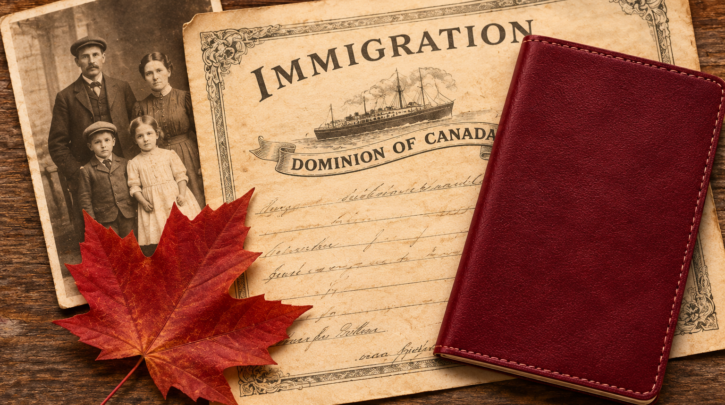

If your Polish ancestors came to North America, they did not all go to Chicago, Detroit or New York. Tens of thousands went to Canada instead, and under a Canadian law that changed in December 2025, some of their American descendants may already be Canadian citizens without knowing it. This is a separate matter from Polish citizenship by descent, but the family research is the same, which makes it worth checking while you are already tracing your line.
Important: This article is general information for educational purposes, not legal advice. Polish citizenship law is technical, depends on the facts of each family line, and is applied case by case by Polish authorities. Verify current requirements with the Polish consulate that serves you or the Polish government’s official citizenship pages, and consider consulting a qualified Polish citizenship lawyer before filing anything. Canadian citizenship is a separate legal system, and you should verify any claim with the Government of Canada’s official citizenship pages or a qualified Canadian lawyer or authorized representative.
Table of Contents
- Why Polish families ended up in Canada
- The Canadian law that changed in December 2025
- Ancestors who arrived before 1947
- Veterans, displaced persons and later arrivals
- How to check whether the line reaches you
- What you would actually apply for
- Canadian and Polish claims are separate
- Next steps
Why Polish families ended up in Canada
For most of the twentieth century, Polish migration to North America split at the Atlantic. Most emigrants went to the major cities of the United States, but a significant stream went north to the Prairies and to Ontario. The timing often came down to US policy. After the Immigration Act of 1924 sharply limited arrivals from Eastern Europe, Canada stayed open, and in the 1920s roughly 130,000 Poles came north, many of them farmers headed for Manitoba, Saskatchewan and Alberta. Plenty of families ended up with branches in both countries. Our history of the Polish diaspora explains the wider story.
The Canadian law that changed in December 2025
For years, Canadian citizenship by descent was capped at one generation born abroad. A child born outside Canada to a Canadian-born parent could be Canadian; a grandchild born abroad generally could not. Bill C-3 changed that, taking effect on 15 December 2025, and it removed the first-generation limit in many situations for people born before that date. Immigration commentators say that if you were born outside Canada before that date to a parent who was a Canadian citizen, you may in most cases already be Canadian, even if that parent’s own citizenship came from the same changes. Newer rules apply to children born abroad after the change and include a requirement that the parent has spent time in Canada, so the position for younger family members is different.
A caution on sources: much of the public commentary on Bill C-3 comes from Canadian immigration firms and trade publications that also sell services. The Government of Canada’s official citizenship pages are the authority, and any specific claim should be checked there or with a qualified professional.
Not sure where to start with your Polish ancestry?
Get the Polish Genealogy Quick-Start Checklist — a 6-step path to your first real ancestor record, plus the 5 terms you’ll see everywhere and direct links to the free archives you need. No subscription required.
Ancestors who arrived before 1947
Canada had no separate citizenship before 1947. Immigrants who arrived and naturalized before then became British subjects, and those who were still living in Canada when the Citizenship Act of 1947 took effect generally became Canadian citizens. That matters because a Polish ancestor who settled on a homestead in the 1920s may have become a Canadian citizen on that date, and citizenship could then pass to children and, under the new rules, further down the line. Naturalization records, homestead files and passenger lists are the documents that tend to establish this. Remember that Polish names turn up in Canadian records under anglicized spellings, dropped letters and partition-era place names, so search for variants (our guide to how Polish surnames changed after immigration shows the patterns).
Veterans, displaced persons and later arrivals
After the Second World War, Canada accepted roughly 4,500 Polish veterans in 1946 and 1947 and many displaced persons through 1952. None of them became citizens on arrival: they landed as workers, refugees or permanent residents, and citizenship came later for those who pursued it. For descendants, the question is whether an ancestor in the line later naturalized and when, because only citizens pass citizenship down. Our guide to researching WWII Polish ancestors, displaced persons and refugees covers how to trace these families.
Searching for the records? A free MyHeritage trial lets you search historical records and family trees for clues (affiliate link).
How to check whether the line reaches you
Work forward from the Canadian branch. Look for a relative who was born in Canada or naturalized there, then trace each birth forward toward you, checking where each person was born and whether their parent was a Canadian citizen at the time. A homestead record, a naturalization file and a passenger list into Halifax can all start a claim. If you have not yet traced your own line, start with our complete guide to tracing Polish ancestry. The same patterns that break Polish chains, such as a naturalization date that precedes a birth, matter here too, though the Canadian rules are different (see what breaks the chain of Polish citizenship for the Polish side).
What you would actually apply for
If you qualify, you do not apply to become a Canadian citizen, because you already are one. What you apply for is a citizenship certificate, the official proof, which can then support a Canadian passport application. Commentators report that the descent route involves no language test, no residence requirement and no oath. If the chain holds for you, it often holds for your siblings and sometimes for cousins as well. Polish ancestry alone makes no one Canadian, and the claim depends entirely on whether a parent in your own line was, or became, a Canadian citizen and whether that status reached you.
Want a professional’s read on your own line? Our guide to finding a Polish citizenship lawyer explains what to look for, what to ask, and which red flags to avoid before you hire anyone.
Canadian and Polish claims are separate
A Canadian citizenship claim and a Polish citizenship claim are independent. One does not depend on the other, and each needs its own proof. The same ancestor can be relevant to both, as when a Polish-born grandparent lived in Canada before moving to the United States, so a single research effort can support two applications. Canada permits dual citizenship, and so does the United States, though you should read our article on Polish citizenship and US dual citizenship law before you build a plan around holding several. Our complete guide to Polish citizenship by descent covers the Polish side in full.
Do you qualify?
Answer two quick questions to see whether your family line may qualify. Free, and it takes about 30 seconds.
Check my eligibility →Next steps
Ask relatives which branch of the family, if any, lived in Canada, and start collecting names, dates and places for that branch. Then compare what you find against the official Canadian guidance. For the Polish claim, our eligibility guide and where to apply explain how to proceed.